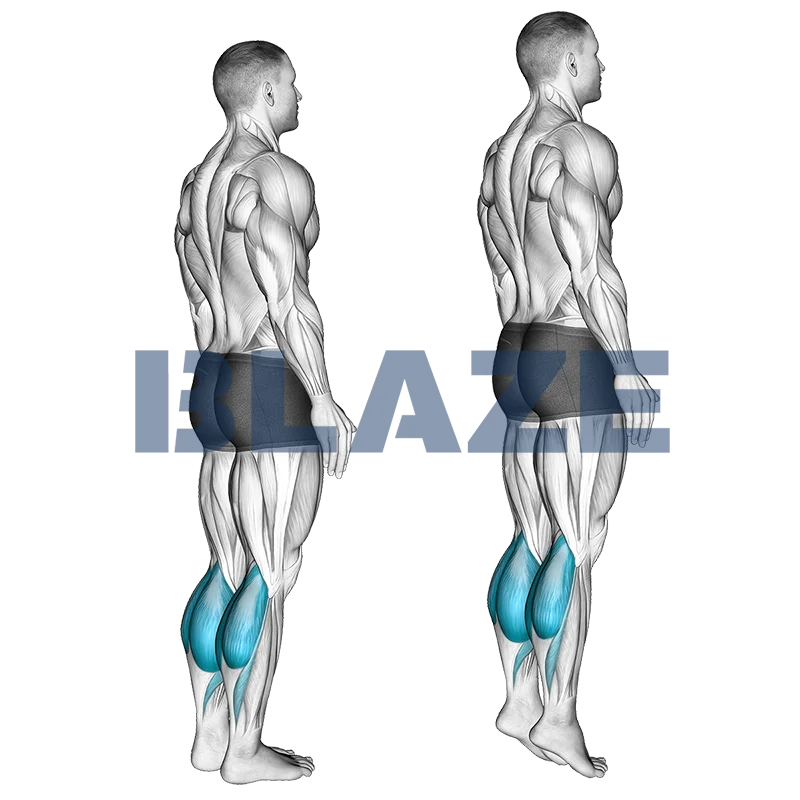
Standing calf raise without weights
Standing calf raise is a beneficial exercise targeting the calf muscles – primarily the gastrocnemius and soleus. It enhances leg strength, improves balance and stability, and reduces the risk of lower leg injuries. Athletes benefit by achieving better sprinting, jumping, and overall lower body endurance. This exercise also supports ankle flexibility and muscle definition, making it a vital addition to any fitness routine aiming for well-rounded leg development.
| Primary muscle group: | Legs |
| Exercise type: | Bodyweight |
| Exercise goal: | Strength |
| Key metric: | Repetitions |
Community Averages
33
Avg. reps/set
Rating
* Based on data from the Blaze community
Description
- 1Adjust the Equipment: Adjust the padded lever of the calf raise machine to match your height.
- 2Position Yourself: Place your shoulders under the pads. Position your toes facing forward (or in one of the other positions specified at the beginning of the chapter). Ensure the balls of your feet are on the calf block with your heels extending off it.
- 3Starting Position: Push the lever up by extending your hips and knees until your torso is erect. Keep your knees slightly bent, not locked. This is your starting position.
- 4Perform the Raise: Raise your heels by extending your ankles as high as possible while breathing out and flexing your calf. Keep your knees stationary and straight.
- 5Hold and Lower: Hold the contracted position for a second, then slowly lower your heels back to the starting position as you breathe in, stretching your calves by bending your ankles.
- 6Repeat: Repeat the movement for the recommended amount of repetitions.
Tips & Tricks
Maintain Proper Posture: Stand upright with a straight back to ensure you maximize the focus on your calf muscles without straining your lower back.
Controlled Movements: Focus on slow, controlled movements. Avoid bouncing or using momentum to lift your heels. This ensures that your calf muscles are doing the work.
Engage Your Core: Keep your core muscles engaged throughout the exercise. This helps with balance and stability, providing a solid foundation for the calf raise.
Full Range of Motion: Aim to achieve a full range of motion by pushing up onto your toes as high as possible and then lowering your heels fully back to the floor. This maximizes muscle engagement.
Balance Support: If you find it difficult to maintain balance, use a wall, chair, or another stable surface for light support. This ensures safety while allowing you to focus on the exercise form.
Foot Position Variation: Experiment with different foot positions-feet pointing slightly inward, parallel, and slightly outward. This targets different parts of the calf muscles, promoting balanced development.
Consistency and Repetition: Consistency is key. Aim to include this exercise regularly in your workout routine. Higher repetitions can be beneficial since you are not using added weights.
Breathing: Practice proper breathing techniques-exhale as you lift your heels and inhale as you lower them. This helps maintain rhythm and muscle endurance.
Mind-Muscle Connection: Concentrate on the mind-muscle connection by really focusing on contracting the calf muscles at the top of the movement. This enhances the effectiveness of the exercise.
Add Pause at Peak: For an added challenge, hold the contraction at the highest point for a couple of seconds before lowering back down. This intensifies the muscle engagement.
Track in the Blaze App
Download Blaze Workout Tracker to log this exercise with sets, reps, and progress tracking.