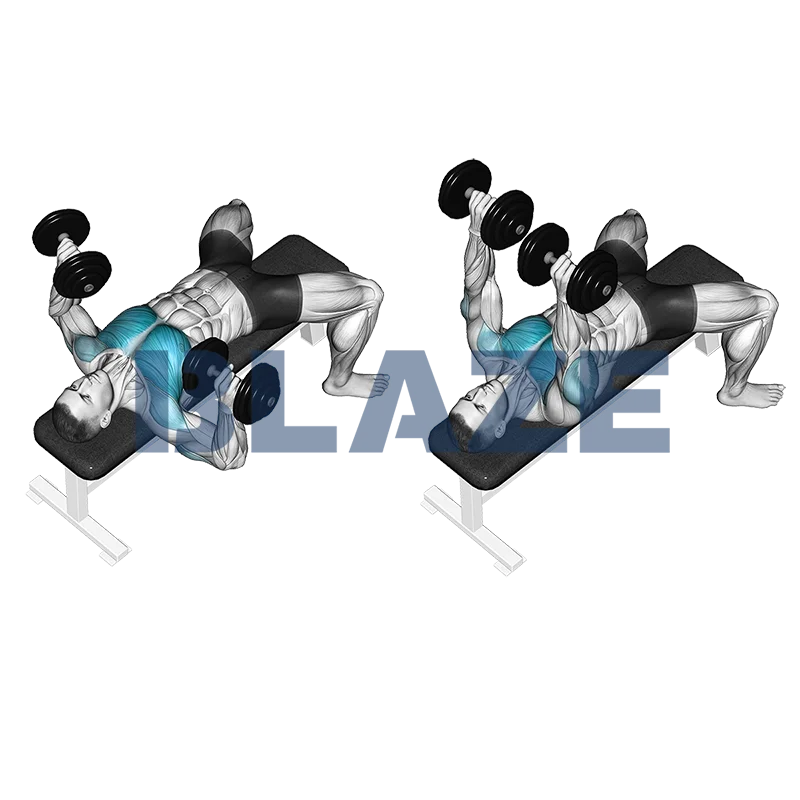
Bench press with dumbbells
The dumbbell bench press is a versatile upper-body exercise primarily targeting the pectoral muscles (chest), triceps, and deltoids (shoulders). By using dumbbells, athletes benefit from an increased range of motion and enhanced stabilization compared to a traditional barbell bench press. This exercise promotes muscle symmetry, reduces muscular imbalances, and improves functional strength, which is crucial for athletic performance. Suitable for all fitness levels, it aids in hypertrophy, strength building, and overall upper-body conditioning, making it a valuable addition to any athlete's training regimen.
| Primary muscle group: | Chest |
| Exercise type: | Dumbbell |
| Exercise goal: | Strength |
| Key metric: | Weight |
Community Averages
37kg
Avg. weight
82lbs
Avg. weight
Popularity
* Based on data from the Blaze community
Description
- 1Hold a dumbbell in each hand, sit on a flat bench and rest one dumbbell on each knee.
- 2While you lie back on the bench, kick each dumbbell up into position resting on your chest, one at a time.
- 3Position the dumbbells to the sides of your chest. Tuck your elbows in to approximately a 45-degree angle.
- 4Place your feet firmly on the ground. Exhale as you press the dumbbells upward and inward until your arms are almost fully extended and the dumbbells nearly touch above the center of your face.
- 5Inhale as you slowly lower the dumbbells back to the starting position. For an extra pump, lower the dumbbells beyond the starting position until you feel a slight stretch in your chest.
- 6You have completed your first repetition. Repeat the motion in a controlled way and count your reps.
Tips & Tricks
Neutral Grip: Hold the dumbbells with a neutral grip, meaning your palms should face each other. This can reduce strain on your shoulders.
Firm Grip: Ensure your grip on the dumbbells is firm but not overly tight to remove unnecessary tension from your arms.
Back Arch: Maintain a natural arch in your lower back. Your buttocks, upper back, and head should remain firmly on the bench.
Foot Placement: Keep your feet flat on the floor for stability. This helps in ensuring a strong base to press from.
Full Extension: Extending your arms fully without locking your elbows ensures maximum muscle activation while keeping your joints safe.
Lowering Dumbbells: Lower the dumbbells to the sides of your chest, creating about a 45-degree angle between your torso and upper arms. This can help in maintaining a natural movement pattern.
Inhale Down: Take a deep breath in while lowering the dumbbells to your chest.
Exhale Up: Exhale as you press the dumbbells back up. This rhythmic breathing can help maintain focus and core stability.
Scapular Retraction: Keep your shoulder blades retracted (pulled together) during the movement. This provides a stable base for pressing and protects your shoulders.
Elbow Path: Keep your elbows at a manageable angle (about 45 degrees from your body) to minimize shoulder strain.
Progress Gradually: Start with a weight that you can handle comfortably for about 8-12 repetitions. Increase the weight gradually as your strength improves.
Control Over Weight: Focus on controlling the dumbbells throughout the entire movement rather than lifting heavier weights with poor form.
Perform a few warm-up sets with lighter weights or even without weights to prime your muscles for the exercise.
Focus on the muscle group you're working on (primarily the chest) to enhance the effectiveness of the workout. This conscious effort can lead to better muscle activation.
If possible, have a spotter, especially when you’re lifting heavy weights. They can assist in maintaining your form and provide safety.
Give yourself adequate rest (about 1-2 minutes) between sets to ensure your muscles recover partially and are ready for the next set.
Incorporate variations like incline, decline, or alternating dumbbell presses to engage different parts of the chest and maintain workout diversity.
Track in the Blaze App
Download Blaze Workout Tracker to log this exercise with sets, reps, and progress tracking.