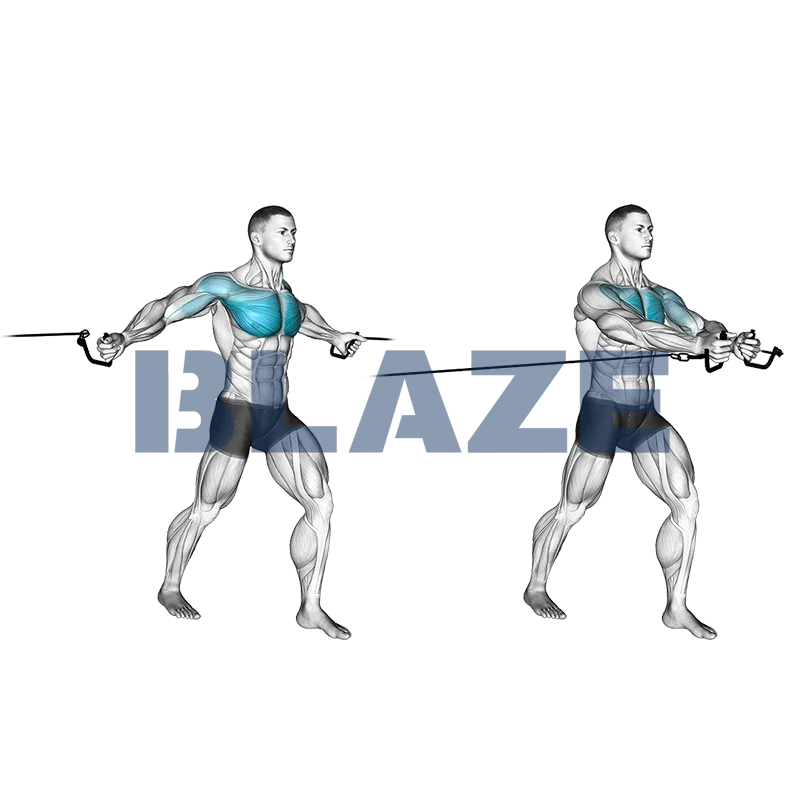
Cable cross over (medium)
The cable crossover is a versatile exercise effective for developing the pectoral muscles, specifically the upper, middle, and lower chest regions. It also engages the anterior deltoids, triceps, and stabilizing muscles. Benefits include improved chest symmetry, enhanced muscle definition, and increased strength. For athletes, this exercise enhances upper body power, aiding in sports requiring push movements like basketball, football, and martial arts. Moreover, it promotes shoulder stability and functional strength, crucial for overall athletic performance.
| Primary muscle group: | Chest |
| Exercise type: | Cable |
| Exercise goal: | Strength |
| Key metric: | Weight |
Community Averages
38kg
Avg. weight
84lbs
Avg. weight
Rating
* Based on data from the Blaze community
Description
- 1Set Up: Stand midway between two pulleys, holding a handle in each hand. Place one foot in front of the other for stability.
- 2Body Position: Bend forward slightly at the hips, keeping your back straight throughout the exercise.
- 3Arm Position: Extend your arms out to your sides with a slight bend at the elbows. Your palms should be facing forward.
- 4Perform the Fly: Exhale as you slowly draw the handles together in an arcing motion until they are positioned in front of your abdomen.
- 5Squeeze and Hold: Hold at the front for a count of two, squeezing your chest muscles.
- 6Return to Start: Inhale as you slowly return the handles to the starting position or until you feel a mild stretch in your chest.
- 7Repeat: Complete the recommended number of repetitions, maintaining proper form throughout.
Tips & Tricks
Maintain Proper Form: Ensure your torso is bent forward at the hips throughout the movement. This targets the chest more effectively and alleviates unnecessary strain on your lower back.
Control the Movement: Focus on slow, controlled movements both on the contraction and the release. This maximizes muscle engagement and reduces the risk of injury.
Adjust Cable Height: Experiment with different cable heights to find which angle activates your chest most. Generally, starting with the pulleys at shoulder height is a good middle ground.
Keep a Slight Bend in Elbows: Avoid locking your elbows. Keeping a slight bend helps maintain tension on the chest muscles and prevents joint strain.
Squeeze at the Peak: When you bring the handles together in front of your chest, squeeze your pectoral muscles for a brief pause. This enhances the contraction and helps build definition.
Mind Your Breathing: Exhale as you bring the handles together and inhale as you return to the starting position. Proper breathing supports better performance and muscle oxygenation.
Progress Gradually: Start with a moderate weight to master form before increasing the load. Gradual progression ensures that you're building strength without compromising technique.
Stable Stance: Keep your feet staggered or at least shoulder-width apart to maintain balance and stability, preventing your body from swaying during the exercise.
Warm Up: Prioritize warming up your shoulders and chest with lighter exercises or dynamic stretches to prepare your muscles and reduce the risk of injury.
Feel the Stretch: On the eccentric phase, allow a full stretch of your chest muscles. This increases muscle activation and contributes to greater hypertrophy.
Track in the Blaze App
Download Blaze Workout Tracker to log this exercise with sets, reps, and progress tracking.