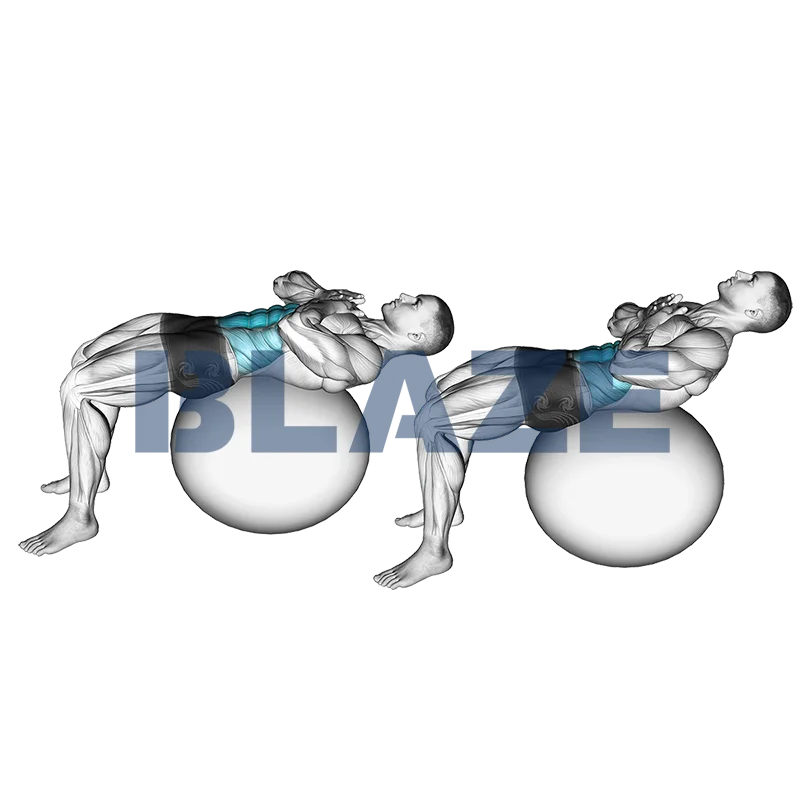
Crunch on stability ball
Ball sit up on stability ball offers significant core strengthening benefits by challenging balance and engaging stabilizing muscles. This exercise primarily targets the rectus abdominis and the obliques, while also activating the lower back, glutes, and hip flexors. Using a stability ball increases difficulty, enhancing muscle coordination and control. Athletes benefit from improved core stability, which translates to better performance in sports requiring balance, agility, and strength. Regular practice can aid in injury prevention and enhance functional fitness.
| Primary muscle group: | Core |
| Exercise type: | Ball |
| Exercise goal: | Strength |
| Key metric: | Repetitions |
Community Averages
127
Avg. reps/set
Popularity
* Based on data from the Blaze community
Description
- 1Position Yourself on the Ball: Lie on an exercise ball with the curvature of your lower back pressed against its surface. Keep your feet bent at the knees and firmly on the floor. Your upper torso should hang off the top of the ball.
- 2Arm Placement: Either keep your arms alongside your body or cross them over your chest. Avoid placing hands behind your head to prevent neck strain.
- 3Stretch and Start Position: Lower your torso into a stretched position, keeping your neck stationary. This is your starting position.
- 4Perform the Crunch: With hips stationary, flex your waist by contracting your abdominals. Curl your shoulders and trunk upward until you feel a contraction in your abs. Allow your arms to either slide up your legs or remain on your chest.
- 5Hold and Breathe: Exhale as you reach the top of the movement and hold the contraction for a second.
- 6Return to Start: Inhale and slowly return to the starting position, maintaining contact between your lower back and the ball.
- 7Repeat: Perform the exercise for the recommended number of repetitions. Ensure control in each move to maximize effectiveness and reduce injury risk.
Tips & Tricks
Choose the Right Ball Size: Ensure your stability ball is the right size for your height. When you sit on the ball, your knees should be at a 90-degree angle.
Find Balance: Start by sitting on the ball with your feet flat on the ground. Walk your feet forward slowly and lean back until your lower back is in contact with the ball, keeping your core engaged to maintain balance.
Foot Positioning: Keep your feet hip-width apart with your knees at a 90-degree angle. This will give you a solid base and help you maintain stability.
Engage Your Core: Focus on engaging your abdominal muscles throughout the entire movement. Think of drawing your belly button towards your spine.
Breathing Technique: Exhale as you crunch up, lifting your shoulder blades off the ball, and inhale as you return to the starting position. Proper breathing can help maximize your ab contraction.
Avoid Pulling Your Neck: Place your hands lightly behind your head or across your chest. Avoid tugging on your neck to lift yourself up; instead, let your abs do the work.
Control Your Movement: Perform each rep in a slow and controlled manner. Slower movements increase the time under tension and enhance muscle engagement.
Full Range of Motion: Aim for a full range of motion by allowing your back to arch slightly over the ball on the way down for a deeper stretch, which can help activate your abs more effectively.
Stabilize with Your Feet: If you're having trouble stabilizing, try positioning your feet wider apart to provide a more secure base.
Consistency Over Speed: Focus on consistency and maintaining good form rather than performing a high number of reps quickly. Quality over quantity will yield better results.
Track in the Blaze App
Download Blaze Workout Tracker to log this exercise with sets, reps, and progress tracking.