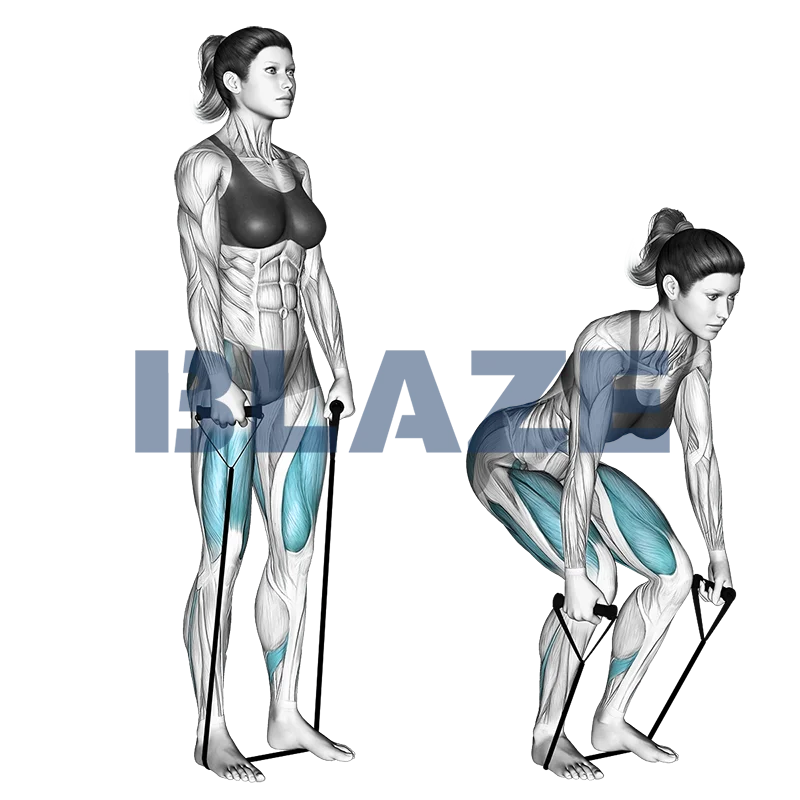
Deadlift with elastic band
The elastic band deadlift is a versatile exercise that offers numerous benefits, including improved strength, stability, and endurance. This exercise primarily targets the glutes, hamstrings, lower back, and core, making it ideal for overall lower body development. Additionally, it engages stabilizer muscles, enhancing balance and coordination. Athletes can profit from the Band Deadlift as it mimics natural movements, helping to prevent injuries and improve performance in sports that require lower body strength and endurance. Its resistance can be easily adjusted, catering to various fitness levels.
| Primary muscle group: | Legs |
| Exercise type: | Band |
| Exercise goal: | Strength |
| Key metric: | Repetitions |
Community Averages
11
Avg. reps/set
Popularity
* Based on data from the Blaze community
Description
- 1Balanced Stance: Stand with your feet flat on the floor, hip-width apart. Ensure your weight is evenly distributed over your mid-foot.
- 2Position the Band: Stand on a resistance band with your feet in the middle. Hold each end of the band with your hands. The closer your hands are to your feet, the higher the resistance will be.
- 3Starting Position: Lean forward from your hips, keeping your shins vertical and a slight bend in your knees. Ensure your back remains flat.
- 4Lifting Movement: Stand up slowly while holding the band. Feel the resistance increase as you rise.
- 5Return to Start: Once fully upright, bend at the hips and return to the starting position in a controlled manner.
- 6Repeat the movement for the desired number of repetitions, maintaining a slow and controlled motion throughout.
Tips & Tricks
Proper Positioning: Ensure the band is properly placed under the arches of your feet, distributed evenly so that it doesn't slip mid-lift.
Engage Core Muscles: Tighten your core throughout the movement for stability and to protect your lower back.
Neutral Spine: Maintain a neutral spine by keeping your back flat and your gaze slightly forward. Avoid rounding your back.
Controlled Movements: Move slowly and with control throughout the exercise to maximize muscle engagement and prevent injury.
Grip Strength: Focus on maintaining a strong grip on the band. If you're having trouble, consider light, grip-strengthening exercises.
Feet Placement: Keep your feet shoulder-width apart. This stance provides a solid foundation for stability during the lift.
Hip Hinge Technique: Focus on your hips doing most of the work. Your hips should move back as you lower and forward as you lift.
Breathing: Inhale as you lower the band and exhale as you lift. Proper breathing helps with maintaining core stability and overall strength.
Progressive Resistance: Start with a lighter band and gradually increase the resistance as your strength improves.
Check Band’s Integrity: Regularly inspect your resistance band for any signs of wear and tear to avoid injuries.
Full Range of Motion: Ensure you are fully extending at the hips, knees, and ankles at the top of the lift for maximum benefit.
Mind-Muscle Connection: Focus on the glutes, hamstrings, and lower back muscles working throughout the movement for enhanced muscle activation.
Warm-Up: Perform a thorough warm-up before starting your deadlifts to prepare your muscles and joints.
Regular Reassessment: Periodically reassess your form and technique, possibly using a mirror or recording yourself, to ensure continued correct performance.
Track in the Blaze App
Download Blaze Workout Tracker to log this exercise with sets, reps, and progress tracking.