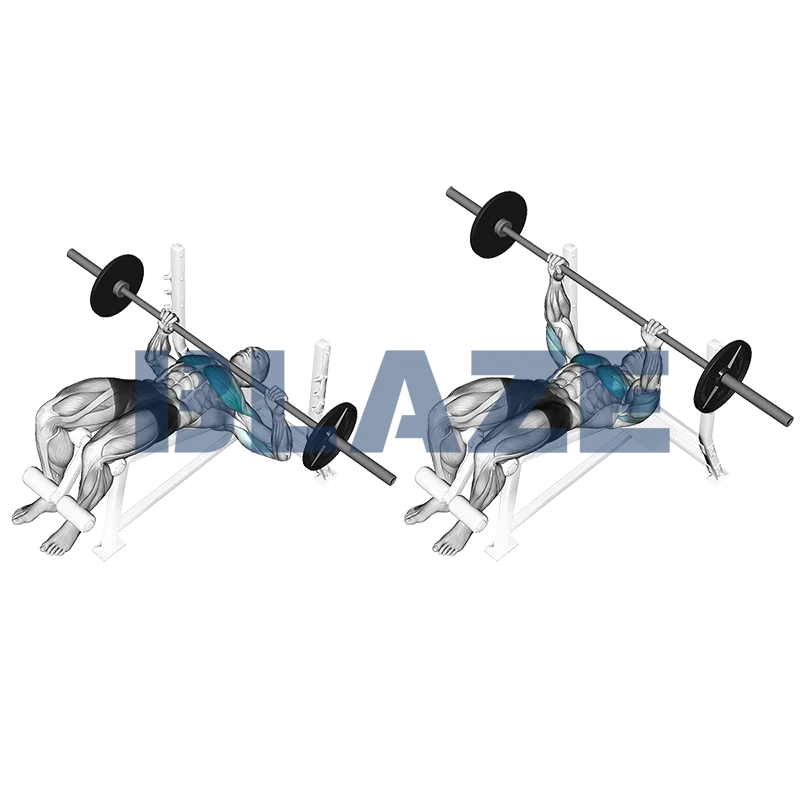
Bench press with barbell (declined)
The barbell declined bench press primarily targets the lower pectoral muscles, while also engaging the triceps and shoulders. This exercise is highly effective for enhancing overall upper body strength and promoting muscle hypertrophy. Athletes can benefit from this exercise as it reduces shoulder strain compared to flat or incline bench presses, making it a safer choice for shoulder health. Increased lower chest development contributes to a balanced and aesthetically pleasing physique, while boosting functional strength essential for various sports and physical activities.
| Primary muscle group: | Chest |
| Exercise type: | Barbell |
| Exercise goal: | Strength |
| Key metric: | Weight |
Community Averages
37kg
Avg. weight
81lbs
Avg. weight
Popularity
* Based on data from the Blaze community
Description
- 1Lie with your back on a declined bench. The bar should be on the level of your eyes.
- 2Place your feet firmly on the ground. Grasp the bar with both hands, your hands should be shoulder-width apart. Push the bar up until your arms are almost fully extended. Straighten your wrists when holding the barbell.
- 3Inhale as you lower the barbell to your chest.
- 4Exhale as you press the barbell back up until your arms are almost fully extended.
- 5You have completed your first repetition. Repeat the motion in a controlled way and count your reps.
Tips & Tricks
Stabilize Your Core: Engage your core muscles to maintain stability and support throughout the movement. This helps to protect your lower back and maximize strength.
Grip Position: Ensure you are using a comfortable overhand grip on the barbell, typically shoulder-width apart. Your grip can significantly impact your lifting efficiency and safety.
Controlled Movement: Lower the barbell slowly and under control to prevent any accidents and to maximize muscle engagement. Speeding through the movements can reduce effectiveness and increase the risk of injury.
Elbow Position: Keep your elbows at about a 45-degree angle relative to your torso during the descent. This helps to reduce stress on your shoulder joints and engages your chest muscles more effectively.
Spotter Assistance: Always have a spotter present, especially when lifting heavy weights. A spotter ensures you can lift safely and helps you push through difficult reps without risking your safety.
Lift-off Technique: When taking the barbell off the rack, ensure you do so with locked arms and a tight grip to avoid any unnecessary strain on your shoulders.
Breathing: Coordinate your breathing with your movement. Inhale as you lower the barbell to your chest and exhale as you press it back up. Proper breathing can enhance your performance and endurance.
Consistent Form: Maintain a consistent form throughout your set to maximize muscle engagement and minimize the risk of injury. Consistency helps develop muscle memory and better results over time.
Leg Drive: Although your legs are positioned and locked into the decline bench, use your leg drive to stabilize your body. This assists in maintaining control and allocating more focus on your chest muscles.
Warm-Up and Cool Down: Always properly warm up before starting heavy lifts to prepare your muscles and joints. After your workout, cool down and stretch to help prevent injury and aid in recovery.
Track in the Blaze App
Download Blaze Workout Tracker to log this exercise with sets, reps, and progress tracking.