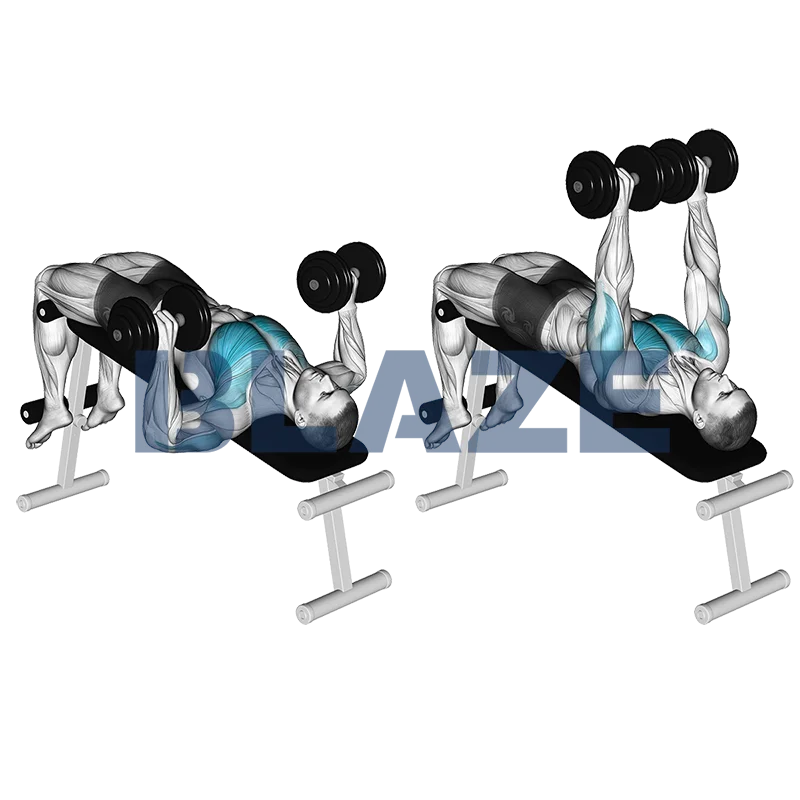
Bench press with dumbbells (declined)
The dumbbell declined bench press is a highly beneficial exercise targeting the lower pectoral muscles, triceps, and anterior deltoids. By performing this movement, athletes can effectively enhance their chest volume and definition while improving upper body strength. The decline angle emphasizes the lower chest, which is often underdeveloped. Athletes benefit from increased muscle engagement and a greater range of motion compared to flat or incline presses. This exercise also aids in better muscular balance and stability, crucial for various sports performance and functional strength.
| Primary muscle group: | Chest |
| Exercise type: | Dumbbell |
| Exercise goal: | Strength |
| Key metric: | Weight |
Community Averages
32kg
Avg. weight
71lbs
Avg. weight
Popularity
* Based on data from the Blaze community
Description
- 1Hold a dumbbell in each hand, sit on a declined flat bench and rest one dumbbell on each knee.
- 2While you lie back on the bench, kick each dumbbell up into position resting on your chest, one at a time.
- 3Position the dumbbells to the sides of your chest and place your feet firmly on the ground.
- 4Exhale as you press the dumbbells upward and inward until your arms are almost fully extended and the dumbbells nearly touch above the center of your face.
- 5Inhale as you slowly lower the dumbbells back to the starting position. For an extra pump, lower the dumbbells beyond the starting position until you feel a slight stretch in your chest.
- 6You have completed your first repetition. Repeat the motion in a controlled way and count your reps.
Tips & Tricks
Optimal Grip: Ensure your grip is firm but not overly tight. This helps in maintaining control of the dumbbells without causing unnecessary tension in your forearms.
Controlled Movement: Lower the dumbbells slowly to maximize muscle engagement. Don't drop the weights; control their path to avoid injury and get the most out of each rep.
Elbow Positioning: Keep your elbows at a 45-degree angle to your torso. This helps protect your shoulders and maximizes chest activation.
Full Range of Motion: Focus on achieving a full range of motion to engage the pectoral muscles completely. Touch the dumbbells lightly to the outer chest before pushing back up.
Stable Core: Keep your core engaged throughout the exercise. This stabilizes your body and helps in maintaining proper form.
Breathing Technique: Exhale as you press the dumbbells upwards and inhale as you lower them. Proper breathing helps in maintaining rhythm and preventing undue pressure on your respiratory system.
Spotter: If you're going heavy, consider having a spotter to help with the initial lift-off and to ensure safety during the exercise.
Bench Angle: Make sure the decline angle is set at around 15-30 degrees. Too steep of a decline can shift the emphasis away from the lower pecs and put unnecessary strain on your shoulders.
Foot Position: Secure your feet under the foot pads if available. This helps in maintaining stability and balance throughout the exercise.
Warm-Up: Warm up properly before performing the decline dumbbell bench press. This prepares your muscles and joints for the workout and helps prevent injuries.
Progression: Gradually increase the weight as you become more comfortable and stronger with the exercise. This will help promote continuous muscle growth and strength gains.
Track in the Blaze App
Download Blaze Workout Tracker to log this exercise with sets, reps, and progress tracking.