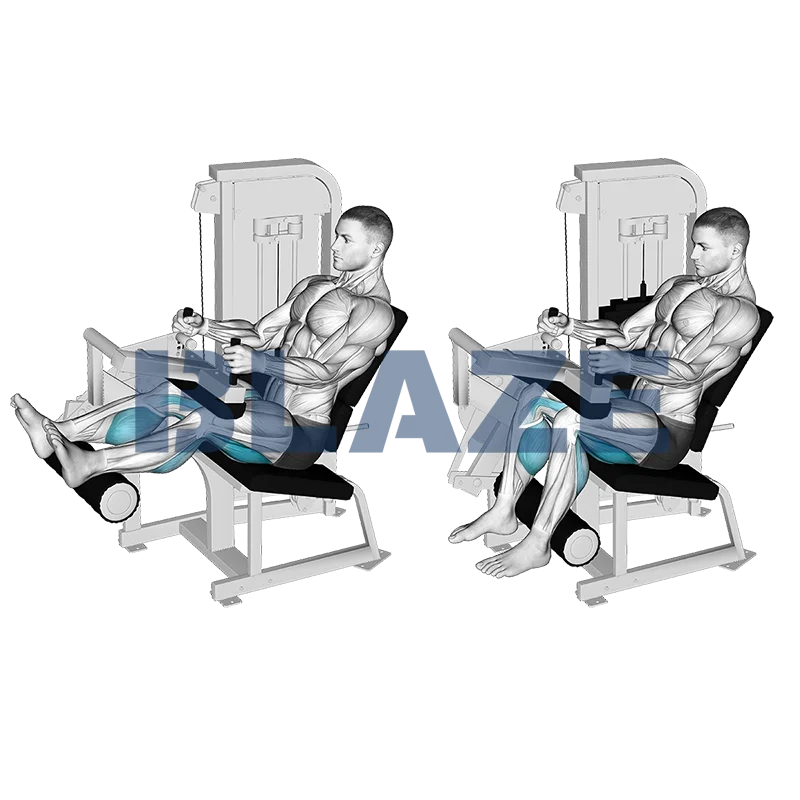
Leg curl on machine (seated)
The machine seated leg curl is a highly effective exercise focusing primarily on the hamstrings, with secondary activation of the calf muscles. This exercise is pivotal for athletes as it enhances lower body strength, contributes to muscle balance, and reduces the risk of injury. Efficiently targeting the hamstrings, it aids in improved sprinting speed, jumping ability, and overall leg endurance. The machine's controlled motion ensures proper form, making it suitable for both beginners and advanced athletes aiming to optimize their performance and athletic capabilities.
| Primary muscle group: | Legs |
| Exercise type: | Machine |
| Exercise goal: | Strength |
| Key metric: | Weight |
Community Averages
43kg
Avg. weight
94lbs
Avg. weight
Popularity
* Based on data from the Blaze community
Description
- 1Adjust the Machine: Ensure the machine’s pads are set up so they sit comfortably against your lower back when seated.
- 2Position Your Legs: Place your legs on the padded lever so it rests just below your calf muscles.
- 3Secure the Lap Pad: Adjust the lap pad so it sits securely on your thighs, just above the knees.
- 4Lift and Grip: Straighten your legs out in front of you and grasp the side handles of the machine.
- 5Execute the Movement: Pull the padded lever down and back towards you using your legs as far as you can.
- 6Hold and Return: Hold the position for a second, then slowly return the lever back to the starting position.
- 7Repeat the movement in a controlled manner for your desired number of repetitions.
Tips & Tricks
Ensure the pad is adjusted to rest comfortably against the back of your lower legs just above the ankles. This helps in maximizing the range of motion.
Breathe out as you curl the weight towards you and breathe in as you slowly return to the starting position. Controlled breathing can enhance your focus and performance.
Perform each repetition through a full range of motion to effectively target your hamstrings. Avoid partial reps to prevent muscle imbalances.
Control both the lifting (concentric phase) and lowering (eccentric phase) of the weight. A slower eccentric phase can enhance muscle growth by increasing time under tension.
Use controlled movements to avoid swinging or using momentum. This ensures the hamstrings are doing the work and reduces the risk of injury.
Focus on feeling your hamstrings work during the exercise. Visualizing the muscle contraction can enhance engagement and effectiveness.
Maintain a flat back against the seat. This helps isolate the hamstrings better and provides stability throughout the exercise.
Frequently monitor your form in the mirror or ask for feedback to ensure you’re performing the exercise correctly. Poor form can lead to reduced effectiveness and potential injuries.
Start with a weight you can control and gradually increase as you gain strength. Overloading too quickly can compromise your form.
Incorporate hamstring stretches post-workout to maintain flexibility and reduce muscle tightness.
Track in the Blaze App
Download Blaze Workout Tracker to log this exercise with sets, reps, and progress tracking.