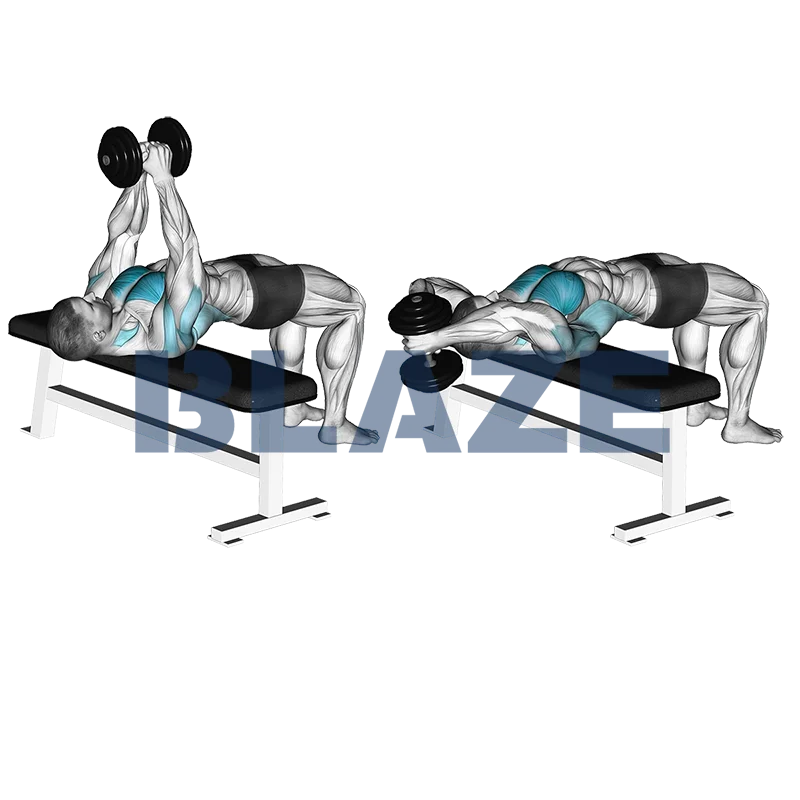
Pullover with dumbbell
The dumbbell pullover is a versatile exercise that primarily targets the chest, lats, and triceps. It's highly effective for increasing upper body strength and enhancing the flexibility of the shoulder joint. Benefits include improved posture and greater upper body stability, which are crucial for athletes. By engaging multiple muscle groups simultaneously, the Dumbbell Pullover boosts overall muscular coordination and endurance. Athletes will profit from this exercise by gaining enhanced muscular balance, joint health, and functional strength, contributing to better performance in various sports.
| Primary muscle group: | Chest |
| Exercise type: | Dumbbell |
| Exercise goal: | Strength |
| Key metric: | Weight |
Community Averages
16kg
Avg. weight
36lbs
Avg. weight
Popularity
* Based on data from the Blaze community
Description
- 1Lie perpendicular on a bench so that only your upper back and shoulders are supported, with your head and lower body extending off the bench. Your lower body should act as a counterbalance.
- 2Hold a dumbbell with both hands directly above your chest, arms nearly fully extended, and palms facing each other.
- 3Exhale as you slowly lower the dumbbell in a backward arc behind your head until your elbows are level with your ears.
- 4Hold this position for a count of two.
- 5Inhale as you slowly raise the dumbbell back over your head to the starting position using the same arcing motion.
- 6Repeat for the desired number of repetitions.
Tips & Tricks
Maintain Proper Form: Keep your elbows slightly bent throughout the movement to ensure the focus remains on your chest and lats, not your triceps.
Control the Weight: Use a weight that allows you to control the movement slowly and smoothly, both in the lowering and lifting phases. Avoid using momentum.
Stable Position: Ensure your upper back is firmly positioned on the bench while performing the exercise. This stability is crucial for maintaining control and engaging the correct muscles.
Range of Motion: Don’t lower the dumbbell too far behind your head. A comfortable stretch is good, but overextending can put unnecessary strain on your shoulders and lower back.
Breathing Technique: Inhale deeply as you lower the dumbbell behind your head and exhale as you bring it back over your chest. Proper breathing helps in maintaining a rhythm and aids muscle engagement.
Mind-Muscle Connection: Focus on the stretch in your chest and lats as you lower the dumbbell. On the way back up, concentrate on these muscles contracting to bring the weight back to the starting position.
Feet Position: Keep your feet flat on the floor to aid in stability and to prevent your lower back from arching excessively.
Warm-Up and Stretch: Ensure you perform a good warm-up and stretching routine before starting to prevent injuries and to get the muscles ready for the exercise.
Avoid Overextension: If you experience discomfort in your shoulders, reduce the range of motion to a zone that feels more comfortable and still effective.
Track in the Blaze App
Download Blaze Workout Tracker to log this exercise with sets, reps, and progress tracking.