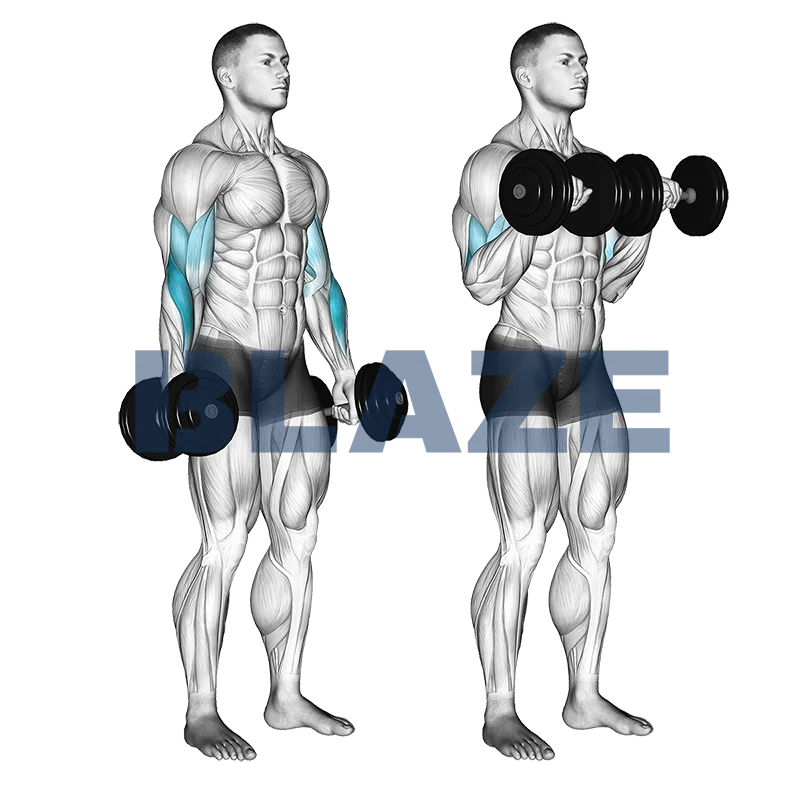
Bicep curl with dumbbells and reverse grip
Dumbbell standing curl (reverse grip) is an effective exercise that primarily targets the brachioradialis and extensor muscles of the forearm, along with secondary activation of the biceps brachii and brachialis. This movement enhances grip strength and forearm development, which are crucial for various athletic activities. Athletes benefit from improved grip and arm endurance, translating to better performance in sports requiring strong, stable upper limbs. Additionally, it aids in preventing common forearm injuries by reinforcing muscular resilience.
| Primary muscle group: | Arms |
| Exercise type: | Dumbbell |
| Exercise goal: | Strength |
| Key metric: | Weight |
Community Averages
17kg
Avg. weight
36lbs
Avg. weight
Popularity
* Based on data from the Blaze community
Description
- 1Stand upright with a dumbbell in each hand.
- 2Rotate your wrists so that you have a shoulder-width, overhand (reverse) grip.
- 3Keep your elbows close to your sides throughout the movement.
- 4Exhale and slowly curl the dumbbells upwards towards your shoulders. Your forearms should nearly reach a vertical position.
- 5Hold the position and squeeze your biceps for a count of two.
- 6Inhale as you gradually lower the dumbbells back to the starting position.
- 7Repeat the exercise for the desired number of repetitions.
Tips & Tricks
Sure, here are some tips and tricks for performing the Dumbbell Reverse Curl effectively:
Use a Lighter Weight: Since the reverse grip emphasizes the brachioradialis and pronator teres muscles more than a traditional bicep curl, you may need to use a lighter weight to maintain good form and avoid strain.
Controlled Movement: Perform the movement in a slow and controlled manner to prevent using momentum. This ensures the muscles work throughout the entire range of motion and reduces the risk of injury.
Elbow Position: Keep your elbows close to your sides throughout the exercise. This helps to isolate the brachioradialis and prevents other muscles from compensating.
Wrist Alignment: Ensure your wrists stay straight and in line with your forearms to avoid unnecessary strain. Do not let them bend upwards or downwards during the curl.
Squeeze at the Top: When you reach the top of the movement, squeeze your forearms and biceps for an added contraction. This can help with muscle growth and definition.
Consistent Breathing: Exhale as you curl the weights up and inhale as you lower them back down. Proper breathing helps maintain stability and focus.
Engage Your Core: Keep your core tight throughout the exercise to maintain good posture and stabilize your body, reducing the risk of lower back strain.
Avoid Swinging: Do not use your body to swing the dumbbells up. If you find yourself using momentum, reduce the weight until you can perform the exercise with strict, proper form.
Warm-Up: Always warm up your muscles before starting the exercise to prepare your joints and muscles, thereby reducing the risk of injury.
Range of Motion: Ensure you are using the full range of motion by fully extending your arms at the bottom and bringing the weights up to shoulder height. This maximizes muscle activation.
Track in the Blaze App
Download Blaze Workout Tracker to log this exercise with sets, reps, and progress tracking.