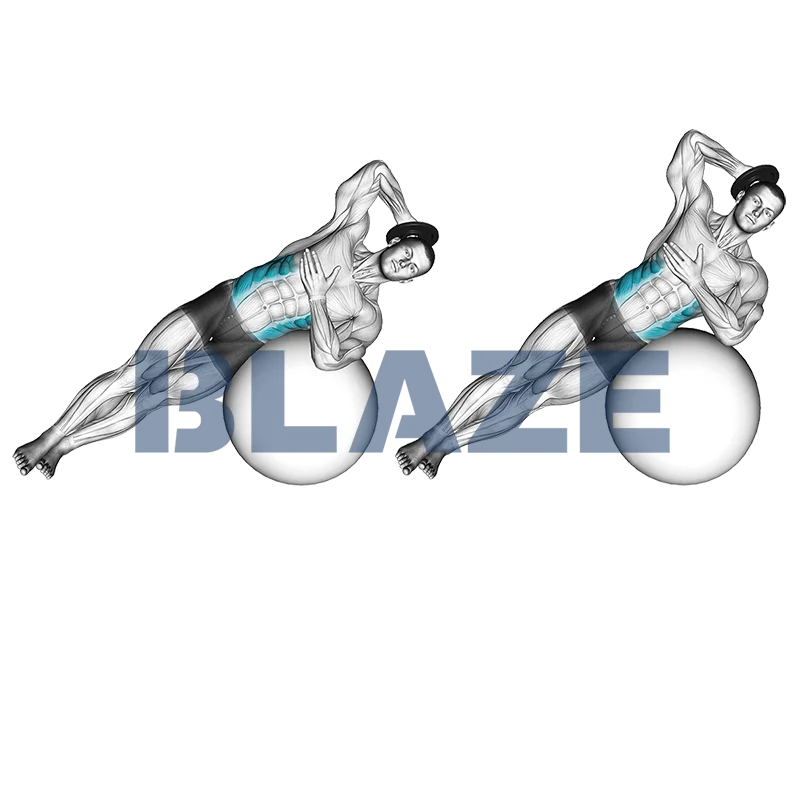
Side bend on stability ball
The side bend on stability ball exercise enhances oblique strength, improves lateral flexibility, and stabilizes the lumbar region. Key muscles activated include the obliques, transverse abdominis, and quadratus lumborum. This exercise benefits athletes by enhancing core stability, which is crucial for balance and effective movement in various sports. Strengthening these muscles also helps prevent injuries, especially in activities requiring rotational movements or lateral bending. Therefore, incorporating this exercise can boost performance and core resilience.
| Primary muscle group: | Core |
| Exercise type: | Ball |
| Exercise goal: | Strength |
| Key metric: | Repetitions |
Community Averages
16
Avg. reps/set
Popularity
* Based on data from the Blaze community
Description
- 1Lie on your side on a stability ball, positioning it under your lower waist and hip.
- 2Extend your legs, placing one in front of the other to maintain stability.
- 3Allow your upper body to drape over the surface of the ball.
- 4Place your hands behind your neck or head.
- 5Exhale while you flex your waist laterally and raise your upper body off the ball until you feel a mild stretch in your side.
- 6Hold the position for a count of two.
- 7Inhale as you slowly lower your upper body back to the starting position.
- 8Repeat for the prescribed number of repetitions, then switch to the opposite side.
Tips & Tricks
Maintain Proper Alignment: Keep your body in a straight line from your head to your toes to ensure you engage the correct muscles and avoid injury. Don't let your hips sag or push too far forward.
Use a Controlled Motion: Avoid using momentum to complete the exercise. Perform the side bend smoothly and deliberately to maximize muscle activation in your obliques.
Engage Your Core: Focus on tightening your core muscles throughout the movement. This helps in maintaining stability and balance on the ball.
Adjust the Ball Position: If you're struggling with balance or want to make the exercise easier, position the ball closer to your hips. For a greater challenge, position it closer to your midsection.
Breathe Properly: Inhale as you lower your torso towards the floor and exhale as you bring your body back to the starting position. Proper breathing will help you manage the intensity of the exercise.
Hand Placement: Keep one hand on your hip or extended along your body to help with balance, while the other hand should gently support your head. Avoid pulling on your neck to prevent strain.
Foot Position: Keep your legs straight and feet firmly planted on the ground. You can place your feet against a wall for extra stability if needed.
Increase Intensity Gradually: As you become more comfortable and stable on the ball, try holding a light dumbbell or medicine ball to increase the resistance and engage your muscles further.
Focus on Form Over Reps: Prioritize correct form and technique over the number of repetitions. Performing a few perfect repetitions is more beneficial than doing many with poor form.
Warm Up and Cool Down: Always start with a warm-up to prepare your muscles and finish with a cool-down to prevent soreness and enhance flexibility.
Track in the Blaze App
Download Blaze Workout Tracker to log this exercise with sets, reps, and progress tracking.