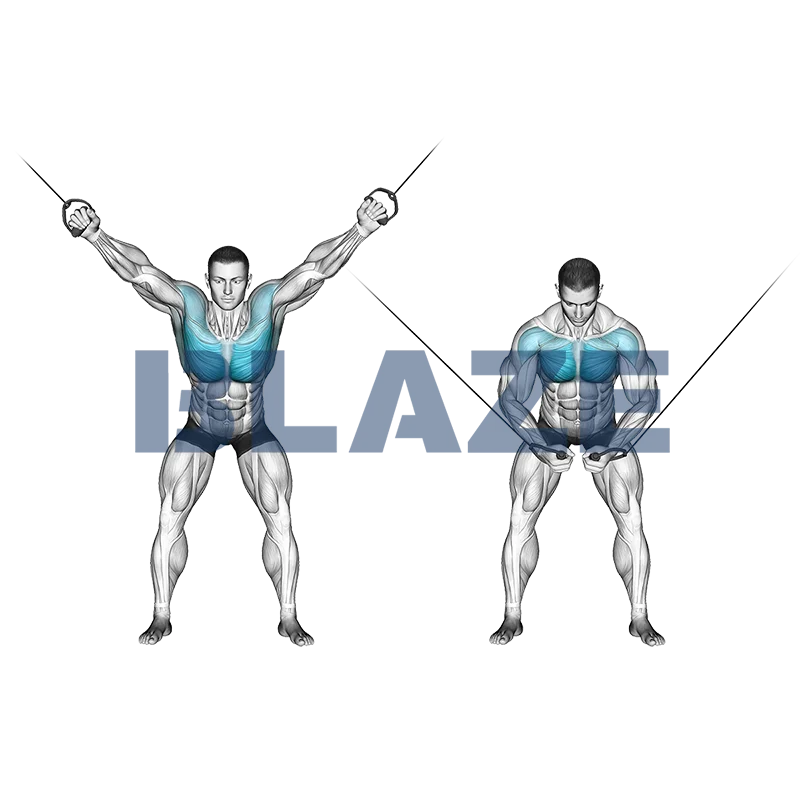
Cable cross over (high)
The cable cross over targets the chest, deltoids, and triceps, enhancing upper body strength and improving muscle tone. This exercise also engages stabilizing muscles, promoting better balance and coordination. Athletes benefit from this movement as it enhances upper body endurance, vital for sports requiring extensive arm use. Its ability to isolate chest muscles makes it ideal for hypertrophy, ensuring even muscle development. Incorporating this exercise can lead to greater overall functional strength and improved athletic performance.
| Primary muscle group: | Chest |
| Exercise type: | Cable |
| Exercise goal: | Strength |
| Key metric: | Weight |
Community Averages
42kg
Avg. weight
93lbs
Avg. weight
Popularity
* Based on data from the Blaze community
Description
- 1Stand between two high pulleys, positioning yourself centrally.
- 2Grasp the stirrup of the left pulley with your left hand and the stirrup of the right pulley with your right hand, using an overhand grip.
- 3Bend forward slightly by flexing your hips and knees.
- 4Rotate your shoulders internally so that your elbows are at shoulder height.
- 5With your elbows slightly bent, exhale and slowly pull the stirrups together in a downward hugging motion.
- 6Hold the position for a count of two and squeeze your chest.
- 7Inhale and slowly reverse the motion until you feel a slight stretch in your chest.
- 8Repeat the exercise for the desired number of repetitions.
Tips & Tricks
Focus on Form: Ensure that your clients maintain a slight bend in their elbows throughout the movement. This will help target the chest muscles more effectively while preventing unnecessary strain on the elbow joints.
Controlled Movement: Advise your clients to use a slow and controlled motion both during the concentric (bringing the cables together) and eccentric (returning the cables to the start position) phases. This enhances muscle activation and reduces the risk of injury.
Mind-Muscle Connection: Encourage them to concentrate on feeling the contraction in their chest muscles. This focus will help ensure that the chest, and not the shoulders or arms, is doing most of the work.
Maintain Tension: Remind clients to keep constant tension on the cables throughout the exercise. Avoid letting the weights rest between reps; this keeps the chest muscles engaged continuously.
Adjust the Pulley Position: The pulley should be set at a high position, ideally above shoulder level. This alignment is crucial for targeting the upper chest muscles effectively.
Neutral Spine: Clients should keep a neutral spine throughout the exercise, avoiding excessive arching or rounding of the back. Proper posture helps distribute the workload appropriately and prevents lower back strain.
Optimal Foot Positioning: A staggered stance (one foot slightly in front of the other) can offer better balance and stability. Encourage them to find a comfortable and solid stance before starting the exercise.
Breathing Technique: Teach your clients to exhale as they bring the handles together and inhale as they return to the starting position. Proper breathing aids in maintaining performance and stability.
Progressive Overload: Advise gradual increases in weight or resistance over time to continually challenge the chest muscles and promote growth and strength gains. Small, incremental adjustments are key to safety and effectiveness.
Warm-Up and Cool Down: Emphasize the importance of warming up the chest and shoulder muscles with dynamic stretches and light cardio before performing the high cable crossover. Follow with a proper cooldown including static stretches to help with recovery and reduce muscle tightness.
Track in the Blaze App
Download Blaze Workout Tracker to log this exercise with sets, reps, and progress tracking.