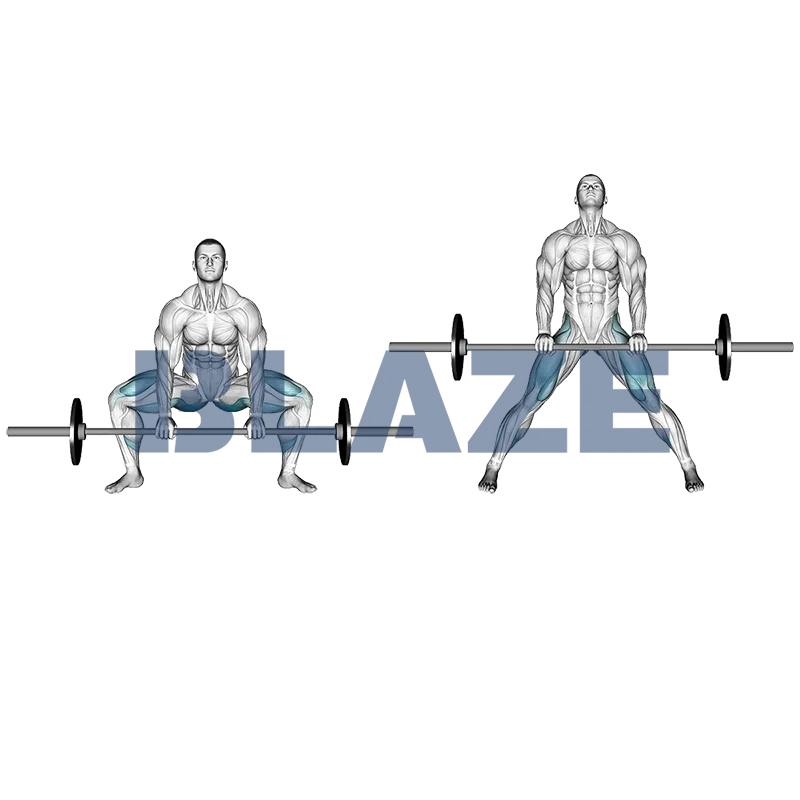
Sumo deadlift with barbell
The barbell Sumo deadlift targets the glutes, hamstrings, quads, and lower back, offering a comprehensive lower body workout. This exercise promotes improved hip mobility and superior leg strength due to its wide stance. Athletes benefit from enhanced power and stability, crucial for sports requiring explosive movements. The sumo stance reduces lower back strain while still engaging essential muscle groups, making it an excellent alternative to conventional deadlifts and an ideal choice for both strength building and injury prevention.
| Primary muscle group: | Legs |
| Exercise type: | Barbell |
| Exercise goal: | Strength |
| Key metric: | Weight |
Community Averages
47kg
Avg. weight
103lbs
Avg. weight
Popularity
* Based on data from the Blaze community
Description
- 1Stand with a wide stance next to the barbell, ensuring your feet and knees point outwards in the same direction.
- 2Flex your hips and grasp the bar with a shoulder-width pronated (overhand) grip.
- 3Flex your knees to lower your hips, bringing them close to the bar. Your torso should be upright, back and arms straight, and head facing forward.
- 4Exhale and drive through your legs, pulling the bar up the front of your body until you are fully standing. Keep the bar close to your body.
- 5Hold for a count of two, pushing your chest out.
- 6Inhale as you flex your knees and lower the bar back to the floor in a controlled manner, maintaining a straight back, upright torso, and head up.
- 7Repeat the motion for the desired number of reps.
Tips & Tricks
Foot Placement: Position your feet wider than shoulder-width apart and turn your toes out at roughly a 30-degree angle. This will help you optimize your leverage and maintain better balance.
Hip Positioning: Keep your hips lower than in a conventional deadlift to maximize the activation of your glutes and hamstrings, but ensure your knees are pointing in the same direction as your toes.
Grip: Use a mixed grip (one hand overhand, one hand underhand) for enhanced grip strength and safety, especially when lifting heavier weights. Alternatively, you can use a double overhand grip to build grip strength.
Core Engagement: Tighten your core and maintain a neutral spine throughout the lift. This will help protect your lower back and improve your overall lifting stability.
Knee Tracking: Make sure your knees track over your toes as you lift the weight. This will help prevent knee injuries and ensure proper form.
Bar Path: The bar should travel vertically upwards as close to your shins as possible. Drag the bar along your legs to maintain an efficient lifting path and prevent unnecessary strain on your lower back.
Breathing: Inhale deeply before you lift and brace your core. Exhale slowly as you complete the lift. Proper breathing can help you maintain stability and control during the movement.
Shoulder Position: Keep your shoulders down and back to engage your upper back muscles and improve your posture during the lift.
Focus on Hips: Concentrate on pushing through your heels and extending your hips forward rather than pulling up with your back. This will engage your glutes and hamstrings more effectively.
Gradual Progression: Start with lighter weights to master your form before gradually increasing the load. Perfecting your technique with lighter weights will help prevent injuries as you progress to heavier lifts.
Track in the Blaze App
Download Blaze Workout Tracker to log this exercise with sets, reps, and progress tracking.