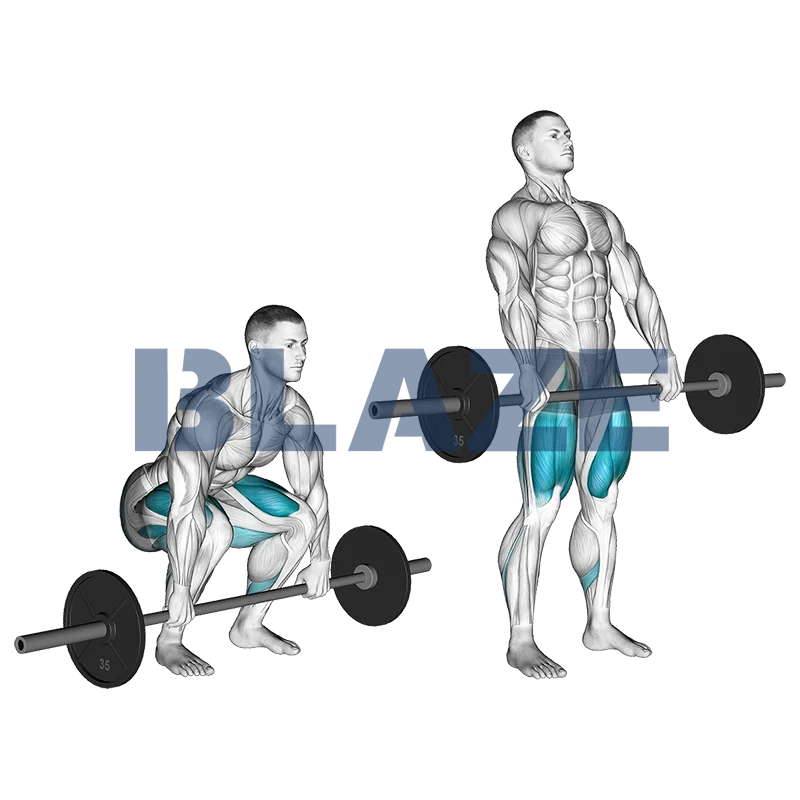
Deadlift with barbell
The barbell deadlift is a powerful full-body exercise that offers numerous benefits for athletes. It primarily targets the glutes, hamstrings, lower back, traps, and core. The exercise promotes muscle growth, enhances strength, and improves posture. Additionally, it aids in developing grip strength and increasing power output, vital for athletic performance. By engaging multiple muscle groups, the deadlift supports functional movement patterns, making it an essential exercise for athletes looking to enhance overall strength and conditioning.
| Primary muscle group: | Legs |
| Exercise type: | Barbell |
| Exercise goal: | Strength |
| Key metric: | Weight |
Community Averages
62kg
Avg. weight
136lbs
Avg. weight
Rating
* Based on data from the Blaze community
Description
- 1Setup: Stand with your feet hip-width apart under the barbell. The bar should be positioned halfway over your feet when you look down.
- 2Grip: Bend down and grasp the barbell with a shoulder-width grip.
- 3Prepare: Take a deep breath, ensuring your torso is upright and your back and arms are straight.
- 4Lift: Stand up by driving with your legs, pulling the bar up the front of your legs.
- 5Top Position: At the top of the lift, squeeze your glutes, pull your shoulders back, and exhale.
- 6Lower:*Push your butt backward and lower the bar down the front of your legs, keeping your back straight.
- 7Finish: Once the bar passes your knees, bend your knees and place the bar back on the floor. Repeat as needed.
Tips & Tricks
Engage Your Core: Always keep your core muscles tight to support your spine and maintain good form throughout the lift.
Proper Foot Placement: Position your feet hip-width apart with your toes slightly pointing outwards. Make sure the barbell is over the middle of your feet.
Grip Tightness: Use a strong overhand grip. If the weight is heavy, consider using a mixed grip (one hand overhand, one hand underhand) or using lifting straps.
Hip Hinge: Focus on hinging at the hips rather than squatting down. Your hips should move back, maintaining a slight bend in your knees.
Neutral Spine: Keep your spine in a neutral position. Avoid rounding or excessively arching your back to prevent injury.
Shoulders: Keep your shoulders slightly in front of the bar at the beginning of the lift and ensure they are not hunched forward.
Bar Path: The barbell should travel in a straight line. Keep it as close to your body as possible, almost grazing your shins and thighs.
Lift with Your Legs: Initiate the lift by driving through your heels and extending your knees and hips simultaneously. Avoid lifting solely with your lower back.
Lockout Position: At the top of the lift, stand tall with your chest up, shoulders back, and your hips fully extended.
Controlled Descent: Lower the barbell back down with control, maintaining the same form as the ascent. Don't just drop the bar.
Breathing: Inhale deeply before lifting to brace your core, and exhale after passing the most challenging part of the lift.
Avoid Overloading: Start with manageable weights and focus on mastering your form before gradually increasing the load.
Track in the Blaze App
Download Blaze Workout Tracker to log this exercise with sets, reps, and progress tracking.