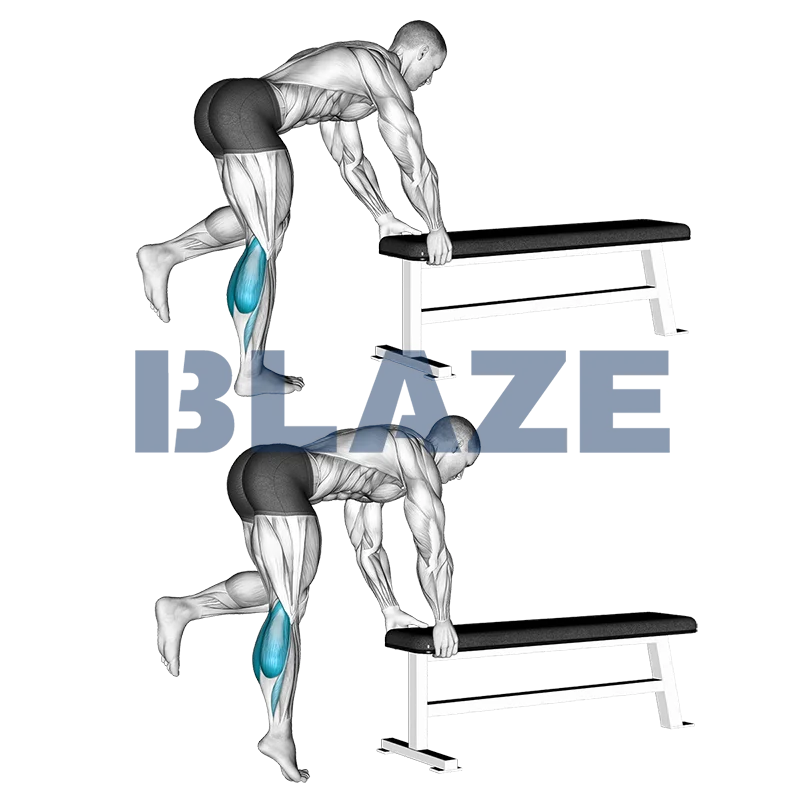
Calf raise leaning forward
The one leg donkey calf raise is a targeted exercise focused on strengthening and defining the calf muscles, specifically the gastrocnemius and soleus. Key benefits include improved balance, increased calf muscle strength, and enhanced lower leg endurance. By performing this exercise, athletes can achieve better ankle stability and explosive power, crucial for sports requiring sudden sprints, jumps, or changes in direction. Additionally, it helps prevent injuries by fortifying the Achilles tendon and reducing muscle imbalances. Ideal for athletes aiming to boost their performance and resilience.
| Primary muscle group: | Legs |
| Exercise type: | Bodyweight |
| Exercise goal: | Strength |
| Key metric: | Repetitions |
Community Averages
17
Avg. reps/set
Popularity
* Based on data from the Blaze community
Description
- 1Setup: Position your lower back and hips under the padded lever of the donkey calf raise machine. Ensure the pad contacts your tailbone area.
- 2Grip: Place both of your arms on the side handles for support.
- 3Foot Placement: Place the balls of your feet on the calf block with your heels extending off. Align your toes forward, inward, or outward based on the target area.
- 4Starting Position: Straighten your knees without locking them. This is your starting position.
- 5Raise Heels: Exhale and raise your heels by extending your ankles as high as possible, flexing your calves. Keep your knees stationary.
- 6Hold: Hold the raised position for a second.
- 7Lower Heels: Slowly inhale and lower your heels back to the starting position by bending your ankles, stretching your calves.
- 8Repeat: Perform the exercise for the recommended number of repetitions.
Tips & Tricks
Engage Your Core: Keep your core engaged to maintain balance and support your lower back. This will help you perform the exercise more effectively and safely.
Slow and Controlled Movements: Avoid rushing through the exercise. Perform each calf raise slowly and with control to maximize muscle activation and reduce the risk of injury.
Full Range of Motion: Make sure to rise up onto the ball of your foot as high as possible and lower your heel down fully. This will ensure that you are working the calf muscle through its complete range of motion.
Balance Support: Use a stable surface or a partner for support if you find it challenging to maintain balance during the exercise. This will allow you to focus more on the calf muscle contraction.
Concentrate on Mind-Muscle Connection: Focus on feeling the calf muscle working during each repetition. This mental connection can increase the effectiveness of the exercise.
Proper Foot Position: Ensure that your working foot is firmly planted and aligned under your hip. This will help maintain proper form and prevent unnecessary strain.
Gradual Progression: Start with fewer repetitions and gradually increase as your strength and balance improve. It's better to perform fewer reps with proper form than many reps with poor technique.
Breathing Technique: Exhale as you raise your heel and inhale as you lower it. Proper breathing helps you maintain rhythm and stability.
Track in the Blaze App
Download Blaze Workout Tracker to log this exercise with sets, reps, and progress tracking.