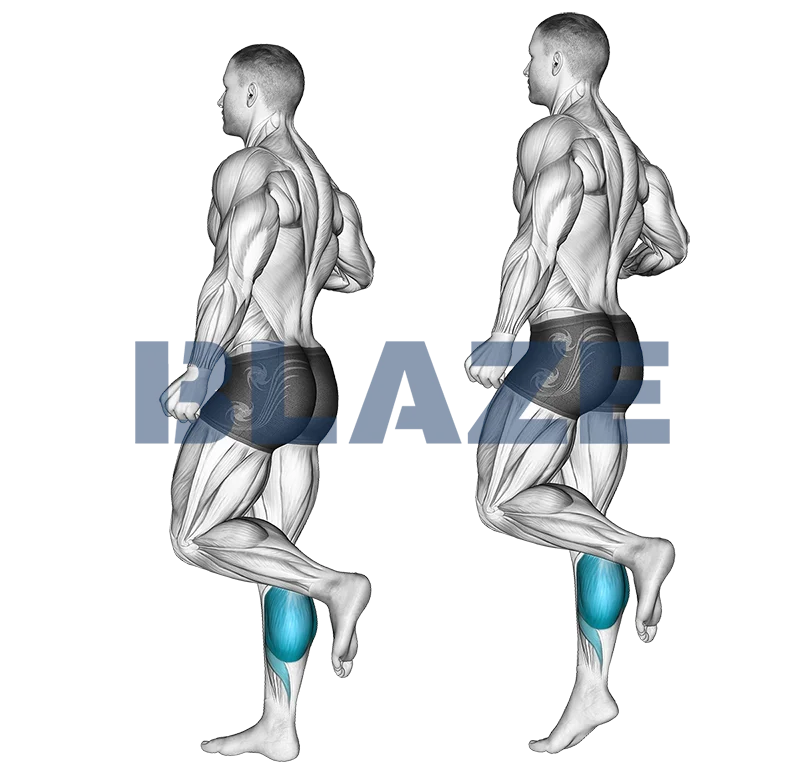
Standing calf raise with one leg
The one leg floor calf raise is a valuable exercise targeting the calf muscles, particularly the gastrocnemius and soleus. By performing this move, athletes can enhance lower leg strength, improve balance, and increase ankle stability. These benefits are essential for activities requiring explosive power and agility like running, jumping, and rapid directional changes. Regular inclusion of this exercise in training routines can contribute to better athletic performance and reduced risk of lower leg injuries. Its simplicity makes it accessible, requiring no equipment.
| Primary muscle group: | Legs |
| Exercise type: | Bodyweight |
| Exercise goal: | Strength |
| Key metric: | Repetitions |
Community Averages
13
Avg. reps/set
Popularity
* Based on data from the Blaze community
Description
- 1Hold a dumbbell in your left hand by your side.
- 2Stand on a platform with your left foot, ensuring the arch and heel of your foot are suspended off the edge.
- 3Use your right hand to grasp something stable for support.
- 4Exhale as you raise your left heel by extending your ankle (plantar flexion).
- 5Hold the raised position for a count of two.
- 6Inhale as you slowly lower your heel (dorsiflexion), feeling a mild stretch in your calf.
- 7Hold the lowered position for a count of one.
- 8Repeat the motion for the desired number of repetitions, then switch to your right leg.
Tips & Tricks
Form First: Always prioritize maintaining proper form over lifting heavier weights. Proper alignment ensures you target the calf muscles effectively and reduce the risk of injury.
Control Your Movement: Perform the exercise in a slow and controlled manner. Avoid using momentum to lift the heel, as this reduces the effectiveness of the movement.
Full Range of Motion: Make sure you achieve a full range of motion by lowering your heel below the level of the step and then rising as high as you can onto your toes. This maximizes muscle engagement.
Balance Support: Use a stable object for support if needed, but try to minimize reliance on it for balance over time as strength and stability improve.
Engage the Core: Always keep your core engaged to maintain better posture and balance throughout the exercise.
Moderate Weights: Start with lighter weights to master the technique before gradually increasing the load. Overloading can compromise form and increase the risk of injury.
Foot Positioning: Position your working foot properly on the edge of the step, so your heel can drop below the step’s level for a full stretch and contraction.
Gradual Increase: Progress slowly by either increasing weights or reps to avoid straining your calf muscles.
Balanced Development: Alternate legs to ensure balanced muscle development. Don't rush through the exercise for each leg; take time to work each calf equally.
Mind-Muscle Connection: Focus mentally on your calf muscles during the exercise. This helps enhance muscle activation and the overall effectiveness of the workout.
Track in the Blaze App
Download Blaze Workout Tracker to log this exercise with sets, reps, and progress tracking.