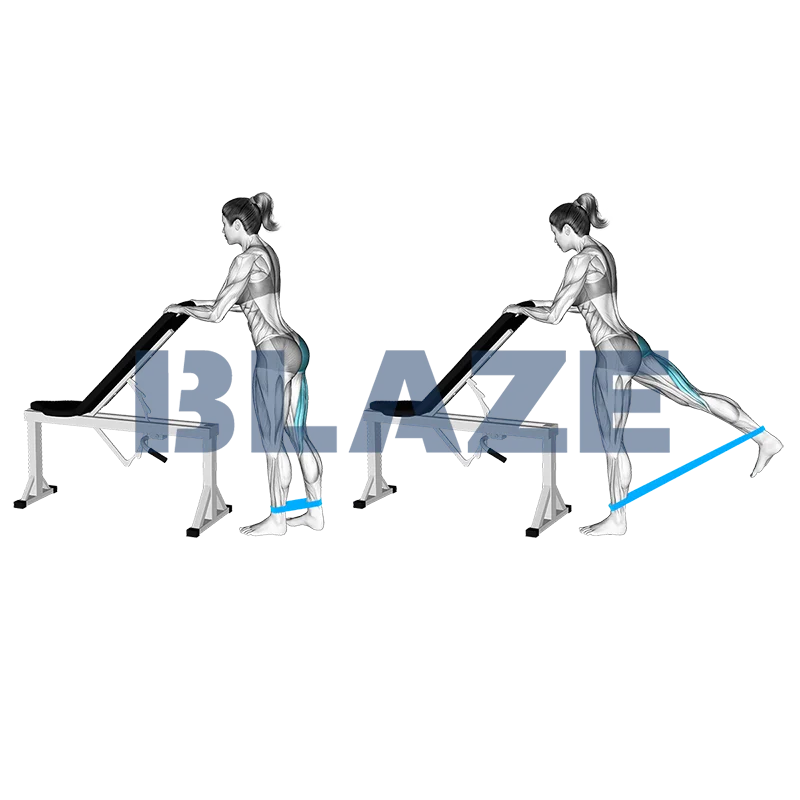
Upright one leg kickback with band
The resistance band one leg kickback is a potent exercise targeting the glutes, hamstrings, and core. Utilizing a resistance band amplifies muscle engagement, enhancing strength and stability in the lower body. This exercise is particularly beneficial for athletes as it improves hip extension power, crucial for activities requiring sprinting, jumping, and dynamic movements. Additionally, it aids in injury prevention by promoting balanced muscle development and strengthening the supporting musculature around the hips and knees. This exercise is an excellent tool for enhancing overall athletic performance.
| Primary muscle group: | Legs |
| Exercise type: | Band |
| Exercise goal: | Strength |
| Key metric: | Repetitions |
Community Averages
18
Avg. reps/set
Popularity
* Based on data from the Blaze community
Description
- 1Anchor the Band: Loop a preferred resistance band around a low and stable anchor point.
- 2Position the Band: Wrap the band around your leg, keeping it below the knee and at or above the ankle. Ideally, position it just below the calf.
- 3Find Balance: Slightly bend at the waist and hold onto a sturdy object, like a chair, for balance.
- 4Prepare Your Stance: Keep a slight bend in the leg that stays grounded. The working leg should be extended straight backward in a controlled, sweeping motion. A slight bend in this knee is acceptable.
- 5Engage the Muscles: Pause and squeeze your muscles at the top of the motion.
- 6Return to Start: Bring your leg back to the starting position.
- 7Repeat: Perform the desired number of repetitions, then switch legs and repeat on the other side.
Tips & Tricks
Proper Band Placement: Ensure the resistance band is securely placed around your ankles. Avoid placing the band too high or too low on your foot to minimize the risk of slippage.
Neutral Spine Position: Maintain a neutral spine by avoiding excessive arching or rounding of your back. This posture helps in effectively targeting the glutes and hamstrings.
Stability: Engage your core muscles to help maintain stability throughout the exercise. This will also enhance your balance and prevent unnecessary movement.
Controlled Movements: Perform both the kickback and return motion in a controlled manner. This enhances muscle engagement and reduces the risk of injury.
Foot Flexion: Keep your foot flexed rather than pointed during the kickback to maximize glute engagement.
Focus on the Working Leg: Concentrate on the leg performing the kickback. This helps in better muscle activation and improves overall form.
Keep the Supporting Knee Slightly Bent: Avoid locking the supporting leg. A slight bend in the knee aids in maintaining balance and reducing strain on the joints.
Range of Motion: Ensure you are moving through a full range of motion for optimal muscle activation. However, do not overextend the leg, as this can lead to strain.
Breathing Technique: Inhale as you prepare to kick back, and exhale as you extend your leg backward. Proper breathing enhances performance and muscle control.
Progression: As you become comfortable with the exercise, consider using a band with higher resistance to further increase the workout intensity.
Visual Focus Point: To aid balance, focus on a stationary point in front of you. This minimizes wobbling and helps you maintain proper form.
Consistency and Repetition: Consistent practice is key. Aim for a specific number of reps and sets, gradually increasing as your strength improves.
Track in the Blaze App
Download Blaze Workout Tracker to log this exercise with sets, reps, and progress tracking.