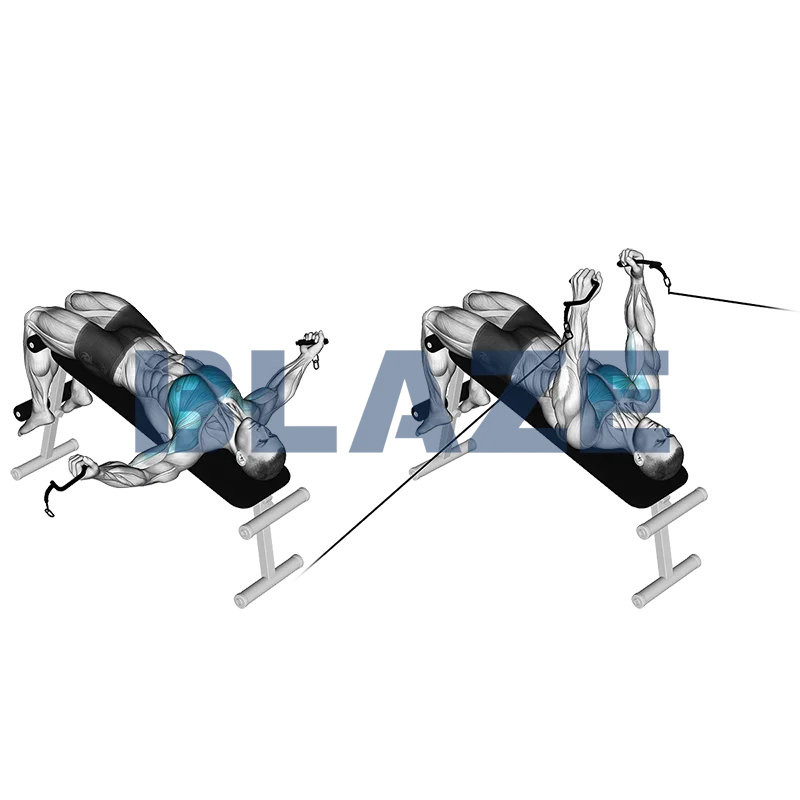
Chest fly with cable (declined)
The cable declined chest fly is a powerful exercise targeting the lower chest (pectoralis major), front deltoids, and triceps. Benefits include improved chest muscle definition and enhanced upper body strength. Engaging stabilizer muscles, this fly promotes better balance and coordination. Athletes profit from improved pushing power, vital for sports like football or boxing, and it aids in overall upper body muscular symmetry. Integrating this exercise bolsters performance, reduces injury risk, and enhances aesthetic physique development.
| Primary muscle group: | Chest |
| Exercise type: | Cable |
| Exercise goal: | Strength |
| Key metric: | Weight |
Community Averages
12kg
Avg. weight
27lbs
Avg. weight
Popularity
* Based on data from the Blaze community
Description
- 1Place a decline bench between two low cable pulleys.
- 2Grasp the stirrups (handles) of each pulley and lie supine on the decline bench, hooking your feet under the pads.
- 3Position the stirrups out to each side and flex your elbows slightly, internally rotating your shoulders so that your elbows point out.
- 4Keep your elbows slightly flexed and exhale as you press the stirrups upward and inward, hugging motion until they nearly touch over your chest.
- 5Hold for a count of two and squeeze your chest.
- 6Inhale as you reverse the motion and return the stirrups towards the starting position, feeling a mild stretch in your chest or shoulders.
- 7Repeat the exercise.
Tips & Tricks
Adjust the bench: Set the bench to a 30-degree decline. This angle targets the lower part of your chest more effectively.
Proper stance: Secure your legs under the support pads to maintain stability throughout the exercise.
Cable height and grip: Position the cables to the lowest setting and choose an appropriate weight. Ensure that you grip the handles comfortably with palms facing up.
Arms slightly bent: Keep a slight bend in your elbows to protect your joints and maintain tension in the pectoral muscles.
Alignment: Your arms should be aligned with your shoulders. This helps in maximizing chest engagement and minimizing shoulder strain.
Control the motion: Move slowly and deliberately. Focus on the eccentric (lowering) phase to fully engage the chest muscles.
Incorporate a wide arc: Perform the fly in a wide arc to increase the stretch and contraction of your pectorals.
Breathing techniques: Inhale as you lower the handles and exhale as you bring them together. Proper breathing enhances focus and performance.
Peak contraction: When your hands meet at the top of the movement, squeeze your chest muscle for a moment before returning to the starting position.
Avoid excessive weight: Choosing a weight that is too heavy can compromise form and increase the risk of injury. Focus on using a weight that allows you to maintain proper form throughout the set.
Regular adjustments: Periodically change the decline angle or combine with incline and flat flies to ensure comprehensive chest development.
Warm-up: Always perform a proper warm-up before starting your workout to prepare the chest muscles and prevent injuries.
Track in the Blaze App
Download Blaze Workout Tracker to log this exercise with sets, reps, and progress tracking.