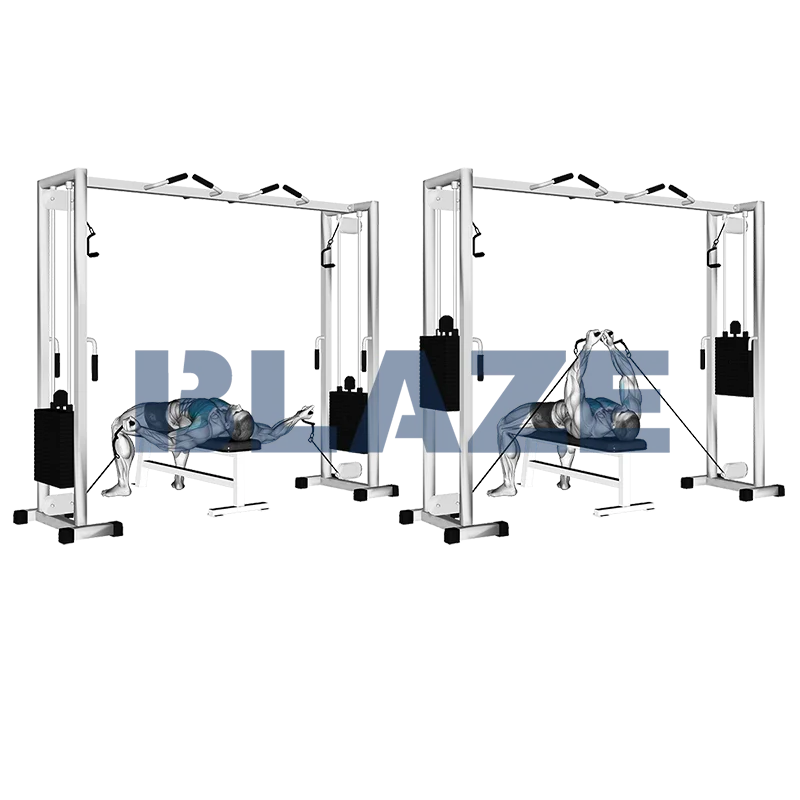
Chest fly with cable on flat bench
The cable lying fly is a beneficial chest exercise activating the pectoralis major, anterior deltoids, and triceps. By utilizing a cable machine, this exercise ensures continuous tension, leading to improved muscle engagement and hypertrophy. Athletes profit from the enhanced strength and stability in their upper body, which is crucial for performance in various sports. Additionally, the controlled movement helps in improving muscle coordination and preventing injuries, making it a valuable addition to any strength training regimen.
| Primary muscle group: | Chest |
| Exercise type: | Cable |
| Exercise goal: | Strength |
| Key metric: | Weight |
Community Averages
34kg
Avg. weight
76lbs
Avg. weight
Popularity
* Based on data from the Blaze community
Description
- 1Place a flat bench between two low cable pulleys.
- 2Grasp the stirrup (handle) of each pulley and lie supine (on your back) between the two pulleys, with your arms extended out to your sides.
- 3Flex your elbows slightly, and internally rotate your shoulders so that your elbows point out to the sides.Arch your back and stick out your chest.
- 4Keeping your elbows slightly flexed, exhale as you pull the stirrups upward and inward in a hugging motion until they touch over your chest.
- 5Hold for a count of two and squeeze your chest muscles.
- 6Inhale as you reverse the motion and lower the stirrups towards the starting position until you feel a mild stretch in your chest or shoulders.
- 7Repeat.
Tips & Tricks
Keep a Slight Bend in Your Elbows: Maintain a slight bend in your elbows to reduce strain on your joints and maintain tension on your chest muscles throughout the movement.
Controlled Movement: Focus on a slow, controlled motion. Avoid letting the weights pull your arms apart too quickly to ensure you are engaging your chest muscles effectively.
Squeeze at the Top: When you bring the cables together above your chest, squeeze your pectoral muscles for a second to maximize muscle contraction and growth.
Maintain Proper Form: Keep your back flat on the bench and avoid arching your spine. Engage your core to help stabilize your body during the exercise.
Full Range of Motion: Ensure you are performing the exercise through a full range of motion. Lower the cables until your arms are nearly in line with your body, then bring them back up above your chest.
Avoid Overstretching: Don’t let your arms go too far back during the lowering phase. Overstretching can lead to shoulder injuries. Your arms should stop just slightly below shoulder level.
Neutral Grip: Keep a neutral grip on the handles. This can help maintain proper alignment and reduce strain on your wrists and elbows.
Consistent Breathing: Inhale as you lower the cables and exhale as you bring them together at the top. Consistent breathing ensures optimal performance and keeps your muscles well-oxygenated.
Start Light: Begin with lighter weights to master the form and technique before progressing to heavier loads. This will help prevent injury.
Focus on Muscle Contraction: Concentrate on using your chest muscles to move the weights rather than relying on momentum or secondary muscles like the deltoids.
Track in the Blaze App
Download Blaze Workout Tracker to log this exercise with sets, reps, and progress tracking.