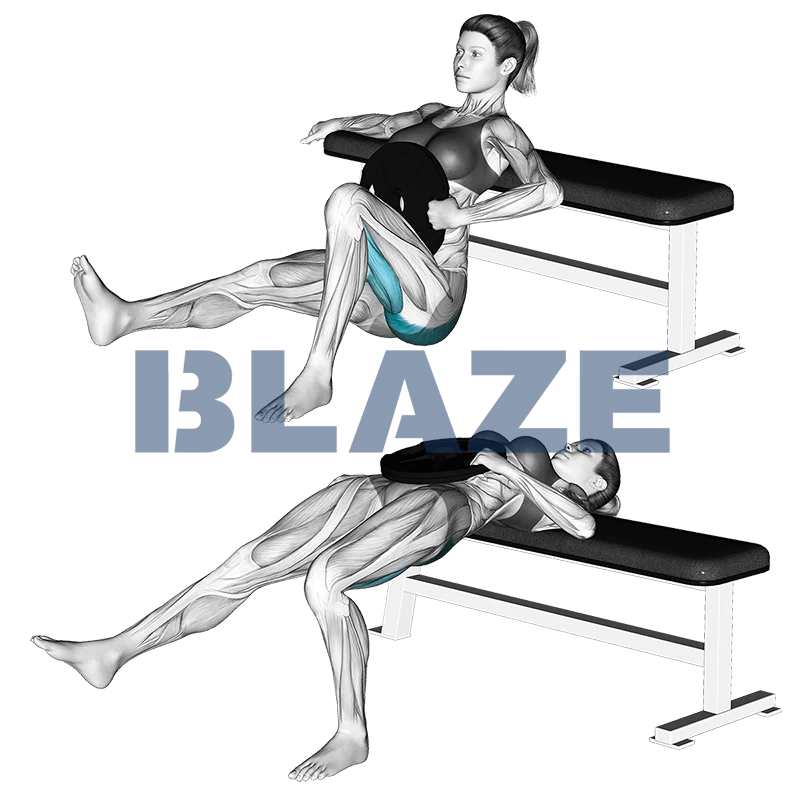
Hip thrust with plate and one leg
The weighted one leg hip thrust is a powerful exercise that targets the glutes, hamstrings, and core muscles, promoting strength and stability. By performing this movement, athletes improve single-leg balance and hip extension, which are crucial for enhancing performance in sports that require sprinting, jumping, and agility. Additionally, the exercise helps correct muscle imbalances and mitigates injury risks. Due to its focus on lower body strength and pelvic control, it is highly beneficial for runners, jumpers, and overall athletic conditioning.
| Primary muscle group: | Legs |
| Exercise type: | Plate |
| Exercise goal: | Strength |
| Key metric: | Weight |
Community Averages
18kg
Avg. weight
39lbs
Avg. weight
Popularity
* Based on data from the Blaze community
Description
- 1Position a loaded barbell parallel to a bench.
- 2Sit on the floor with your hips under the barbell and your back resting against the side of the bench.
- 3Grasp the barbell with both hands, one on each side.
- 4Bend your knees and place your feet flat on the floor.
- 5Keeping your torso rigid, exhale as you lift the barbell by extending the hip of one leg until your hip is fully extended.
- 6Hold for a count of two and squeeze your glute.
- 7Inhale as you lower the barbell by flexing your hip, but do not let the barbell touch the floor.
- 8Repeat for the desired number of repetitions, and then switch to the opposite leg.
Tips & Tricks
Master the Bilateral Hip Thrust First: Ensure you are proficient with the standard two-leg hip thrust before progressing to the one-leg variation. This guarantees you have the necessary strength and technique to perform the move safely.
Optimal Bench Height: Use a bench that is around knee height. This allows for a full range of motion and helps in maintaining proper form.
Focus on Your Hips: Concentrate on driving through your heel and extending your hip fully at the top of the movement. This ensures maximum glute activation.
Controlled Movements: Perform the exercise in a controlled manner. Avoid rushing through the reps; control both the ascent and descent phases of the movement to enhance muscle engagement.
Plate Positioning: Place the plate on your working-side hip. Make sure it is secured and balanced to prevent shifting, which can disrupt your form.
Keep Your Core Tight: Engage your core throughout the exercise. This helps in maintaining stability and prevents undue stress on your lower back.
Alignment and Posture: Maintain a straight line from your shoulders to your knee when your hips are extended. This ensures you're using the correct muscles and reduces the risk of injury.
Foot Placement: Position your working foot flat on the ground, directly below your knee. This aligns the joint properly and enhances stability.
Avoid Hyperextension: Do not hyperextend your back at the top of the movement. Once your hips are in line with your torso, that's your end point.
Incorporate Progressive Overload: Gradually increase the weight of the plate or the number of repetitions over time. This will continuously challenge your muscles and promote growth and strength gains.
Breathe Properly: Inhale as you lower your hips and exhale as you thrust them upward. Proper breathing ensures better oxygen flow and enhances performance.
Track in the Blaze App
Download Blaze Workout Tracker to log this exercise with sets, reps, and progress tracking.