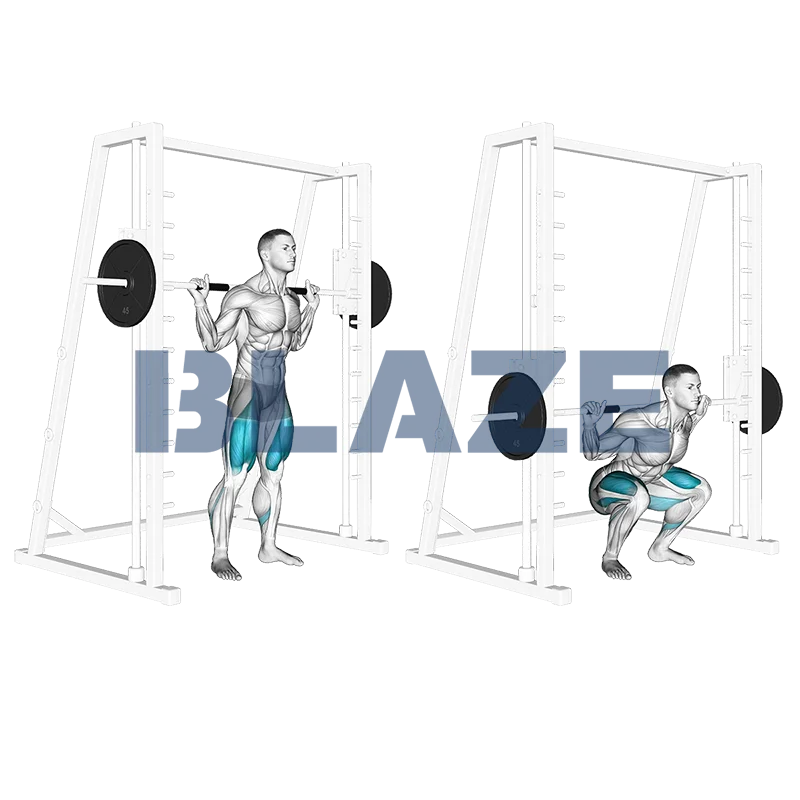
Squat on Smith machine
The Smith machine squat is an excellent exercise for building lower body strength, stability, and muscle endurance. It primarily targets the quadriceps, glutes, hamstrings, and calves. By guiding the bar on a fixed plane, the Smith machine provides added safety and balance, making it an ideal choice for both beginners and advanced athletes. This stabilization allows athletes to focus more on muscle activation and less on form. Enhanced lower body strength from performing Smith Squats contributes to improved performance in sports requiring powerful legs, such as sprinting, jumping, and changing direction quickly.
| Primary muscle group: | Legs |
| Exercise type: | Machine |
| Exercise goal: | Strength |
| Key metric: | Weight |
Community Averages
54kg
Avg. weight
119lbs
Avg. weight
Popularity
* Based on data from the Blaze community
Description
- 1Set Up the Equipment: Adjust the safety pins of the Smith machine to a height that would prevent injury if you can't lift the bar. Position the bar just under shoulder height.
- 2Position Yourself: Stand under the bar with it resting across the back of your shoulders. Grasp the bar at both sides. Your feet should be shoulder-width apart and slightly pointed outwards.
- 3Unlatch the Bar: Rotate the bar to unlatch it from the rails.
- 4Perform the Squat: Keeping your torso upright, inhale and squat by pushing your hips back and bending your knees. Lower until your thighs are at least parallel to the floor.
- 5Return to Start: Exhale and push through your heels to stand back up to the starting position.
- 6Repeat: Perform the prescribed number of repetitions.
- 7Secure the Bar: Once finished, rotate the bar to latch it back onto the rails.
Tips & Tricks
Positioning: Ensure your feet are positioned slightly ahead of you. This helps to balance the pressure between your knees and hips, reducing the risk of knee strain.
Foot Placement: Varying your foot placement can target different muscle groups. A wider stance hits the inner thighs more, while a narrower stance focuses on the outer thighs and glutes.
Grip and Bar Placement: Place the bar across your traps or slightly lower on your rear deltoids (depending on comfort and preference), and ensure your grip is even to maintain balanced weight distribution.
Knee Alignment: Keep your knees in line with your toes throughout the movement. Avoid letting your knees collapse inward to prevent unnecessary stress on your ligaments.
Depth Control: Aim to lower your body until your thighs are parallel to the floor, or slightly lower if flexibility and mobility allow. Ensure to maintain proper form and avoid any rounding of the lower back.
Core Engagement: Tighten your core muscles throughout the movement. Holding your core steady will provide stability and protect your lower back.
Breathing Technique: Inhale deeply as you lower into the squat and exhale as you push back to the starting position. Proper breathing techniques help you maintain form and generate power.
Starting Weight: Begin with a lighter weight to master your form and technique, then gradually increase the load. Proper form is more important than lifting heavy weights.
Tempo and Control: Perform the movement in a controlled manner. Avoid bouncing at the bottom of the squat; instead, use a smooth and steady pace.
Use of Safety Mechanisms: Utilize the safety catches on the Smith machine to set a limit that prevents the bar from going too low. This adds an extra layer of safety, especially when lifting heavier weights.
Track in the Blaze App
Download Blaze Workout Tracker to log this exercise with sets, reps, and progress tracking.