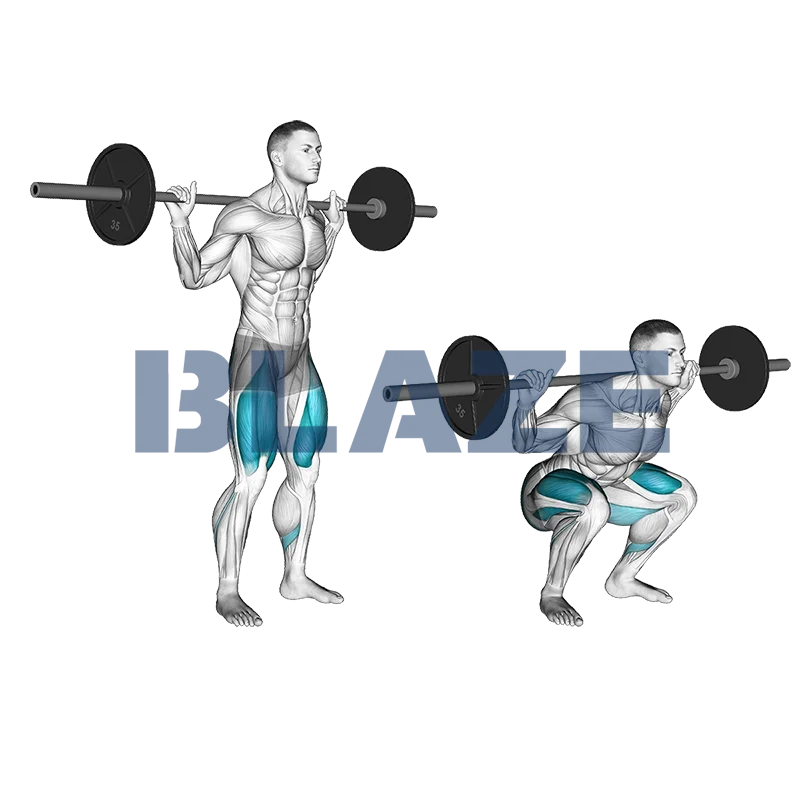
Squat with barbell
The barbell squat is a foundational exercise that offers multiple benefits, including improved strength, power, and muscle mass. Key muscle groups activated during this exercise include the quadriceps, hamstrings, glutes, and lower back. For athletes, incorporating barbell squats can enhance performance by promoting better balance, agility, and explosiveness, which are crucial for sports like football, basketball, and track. Additionally, squats improve core stability and support injury prevention by strengthening connective tissues and joints.
| Primary muscle group: | Legs |
| Exercise type: | Barbell |
| Exercise goal: | Strength |
| Key metric: | Weight |
Community Averages
55kg
Avg. weight
122lbs
Avg. weight
Popularity
* Based on data from the Blaze community
Description
- 1Load a barbell on a rack at upper-chest level. Step under the barbell so that it rests on the back of your shoulders, and grasp the bar at each side. Hands are slightly wider than shoulder-width apart.
- 2Dismount the barbell and step backward. Your feet should be shoulder-width apart and must slightly point outwards.
- 3Inhale as you squat down by simultaneously pushing the hips back and bending your knees and hips to lower the torso. Keep your torso upright, and descend at least until your knees are bent at a 90-degree angle.
- 4Be careful that your knees do not extend beyond an imaginary line drawn vertically upward from your toes. Instead, push your butt backwards to avoid this.
- 5Exhale as you push your body back up to the starting position, still keeping your torso upright.
- 6You have completed your first repetition. Repeat the motion in a controlled way and count your reps.
Tips & Tricks
Warm-Up Thoroughly: Always start with a comprehensive warm-up to prepare your muscles and joints. This can include dynamic stretches and light cardio to get your blood flowing.
Head Position: Keep your head facing forward and eyes fixed on a point in front of you. This helps maintain balance and keeps your spine aligned.
Chest Up: Ensure your chest is up and your back is neutral throughout the movement. Avoid rounding your back to prevent spinal injuries.
Hips and Knees: Your hips should move back and down, with your knees tracking over your toes, not caving inward.
Grip Width: Hold the barbell with a grip that is slightly wider than shoulder-width.
Bar Placement: Place the barbell securely on the trapezius muscles (high-bar squat) or the rear deltoids (low-bar squat).
Foot Placement: Position your feet shoulder-width apart or slightly wider, with your toes pointed slightly outward.
Inhale: Take a deep breath in before descending.
Exhale: Breathe out as you press back up to the starting position. Effective breathing stabilizes your core and provides power for the lift.
Depth of Squat: Aim to lower yourself until your thighs are parallel to the ground or slightly below, depending on your flexibility and strength. Perfect your form before attempting deeper squats.
Core Engagement: Keep your core muscles engaged throughout the movement to provide stability and protect your lower back.
Progress Gradually: Start with lighter weights to perfect your form before gradually increasing the load. Prioritize technique over heavy lifting to avoid injuries.
Use Safety Measures: If you’re lifting heavy, ensure you use a squat rack with safety bars set at an appropriate height. Don’t hesitate to ask for a spotter if needed.
Mind-Muscle Connection: Focus on the muscles you are working, particularly the quadriceps, hamstrings, and glutes. This increases activation and effectiveness of the exercise.
Track in the Blaze App
Download Blaze Workout Tracker to log this exercise with sets, reps, and progress tracking.